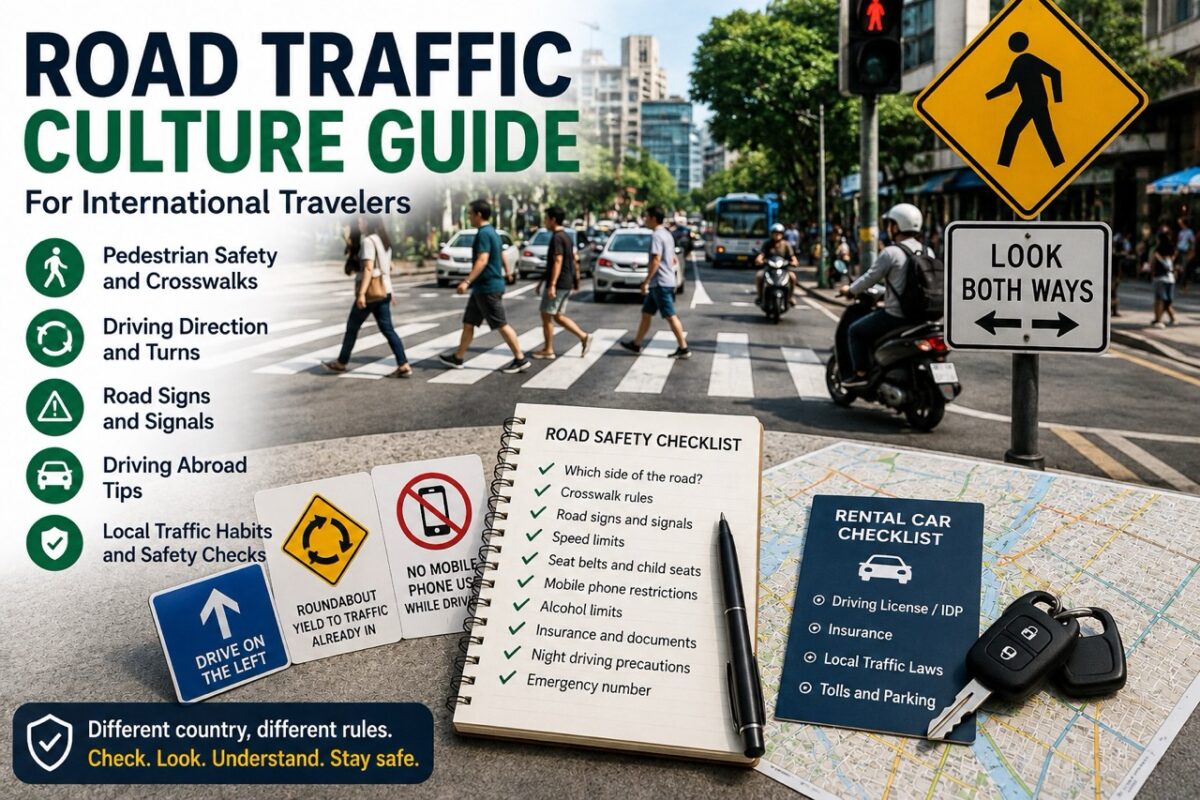
Road traffic culture can feel different abroad even before you rent a car. The side cars drive on, how drivers treat crosswalks, how scooters move through traffic, and when pedestrians are expected to wait can all change by country, city, or even neighborhood.
This road traffic culture guide explains what international travelers should check before walking, crossing roads, riding in taxis, using scooters or bikes, or driving a rental car abroad. The goal is not to memorize every traffic law in the world. It is to notice the local road habits that affect your safety from the first day of the trip.
Quick answer: before using roads abroad, check which side traffic comes from, whether drivers usually yield at crosswalks, how turning vehicles behave, what the basic road signs mean, and what documents or rules apply if you plan to drive.
What this road traffic culture guide helps you check
Travelers use roads in more ways than they realize. Even if you never drive, you still cross streets, stand near bus stops, get out of taxis, walk through parking areas, use ride-hailing pickup zones, or share sidewalks with bikes and scooters. A road rule that feels obvious at home may not work the same way abroad.
The first thing to check is pedestrian behavior. Do people wait for the signal even when the road looks empty? Do drivers slow down at marked crossings? Are scooters allowed near sidewalks? Are bike lanes separated clearly, or do they run close to pedestrian space?
The second thing to check is traffic direction. In some countries, vehicles drive on the right. In others, they drive on the left. That changes which way you instinctively look first, how turning vehicles approach, and how roundabouts feel if you are driving.
The third thing to check is local enforcement. Some places rely heavily on speed cameras, bus lane cameras, red-light cameras, parking controls, or strict mobile phone rules. Others may have rules that exist on paper but feel less predictable in daily traffic. For broader planning by destination, keep road traffic culture guide open while checking local transport and safety basics.
Pedestrian safety abroad starts before the crosswalk
Most travel road-safety mistakes begin before the traveler reaches the middle of the street. You may step off the curb while looking the wrong way, follow locals through a risky gap, stand in a bike lane while reading a map, or assume a driver will stop because the crossing is marked.
Start with a slower first day. When you arrive in a new country, take a few minutes to watch how local pedestrians cross. Do they wait for the green walking signal? Do drivers stop early or roll through slowly? Do scooters pass between lanes? Do buses turn close to the curb? A short observation can teach you more than a sign you barely understand.
Use sidewalks where they exist, and avoid walking on road shoulders unless there is no safe alternative. At night, stay visible and avoid dark roadside walking, especially on rural roads, resort roads, and places without a clear pedestrian path. If you are traveling with children or older family members, choose crossings with signals or refuge islands when possible.
Look for turning vehicles, not only straight traffic
Many visitors watch the traffic lane directly in front of them but forget turning vehicles. A car turning right or left can enter the crosswalk just as pedestrians start crossing. Buses and trucks need more space to turn, and scooters may move through gaps that cars cannot use.
At large intersections, look across all approaching lanes before stepping forward. A green walking signal is helpful, but it does not remove the need to watch for turning traffic, emergency vehicles, delivery bikes, or drivers who enter the intersection late.
Crosswalk rules and local habits can be different
A marked crosswalk does not feel the same in every country. In some places, drivers commonly stop as soon as a pedestrian approaches the crossing. In others, pedestrians may wait until the road is clear even when a zebra crossing is painted on the street. Local habits can also differ between tourist centers, residential neighborhoods, and fast suburban roads.
Signalized crossings are usually easier because the pedestrian light tells you when to move. Still, check whether turning vehicles are allowed during the pedestrian phase. Unsignalized crossings require more judgment. Make eye contact when possible, wait for vehicles to slow clearly, and do not assume the first stopped car means every lane is safe.
Multi-lane roads deserve extra caution. One driver may stop, but another driver in the next lane may not see you. This is especially risky when a bus, van, or large SUV blocks visibility. If the crossing does not have a signal, walk only when you can see all active lanes clearly.
Do not copy locals blindly
Local pedestrians may cross in ways that look confident but depend on years of habit. They may know the signal timing, driver behavior, traffic speed, or informal rules of that street. As a visitor, you do not have that context yet.
Following a crowd can sometimes be safe, but it can also pull you into a crossing before you have checked the direction of traffic yourself. If you are tired, jet-lagged, carrying luggage, or walking with children, choose the slower and clearer option.
Driving direction: left side, right side and first-day confusion
Driving direction affects travelers even when they are only walking. If you come from a right-driving country and visit a left-driving country, your first instinct at the curb may be wrong. The same is true in reverse. This is why some cities paint “look left” or “look right” warnings near busy tourist crossings.
Before crossing, pause and look both ways every time, even if you think you know where traffic should come from. At the beginning of a trip, make this a deliberate habit rather than relying on instinct. Your brain may still be using the road pattern from home.
If you plan to drive in a country where traffic runs on the opposite side from home, the first day is the hardest. The car may place the driver on the other side, the gear selector may feel different, and turns require extra attention. Roundabouts can also feel reversed because traffic circulates in the opposite direction from what your body expects.
Do not schedule your most difficult drive immediately after a long-haul flight if you can avoid it. Fatigue, jet lag, unfamiliar roads, and opposite-side driving are a bad combination. If you need to drive on arrival day, choose a simple route, avoid rush hour, and give yourself more time than the navigation app suggests.
Road signs, signals and lane markings travelers should notice
Road signs are not just for drivers. Pedestrians, cyclists, scooter users, taxi passengers, and bus riders all benefit from noticing basic signs and lane markings. A no-entry sign can explain why cars appear from only one direction. A bus-only lane can show where not to stand while waiting. A bike lane marking can tell you where scooters or cyclists may appear quickly.
Start with the signs that affect your immediate safety: pedestrian signals, no-entry signs, one-way signs, bus lanes, bike lanes, school-zone signs, tram tracks, speed cameras, red-light cameras, and railway crossings. In some cities, camera enforcement can be strict, and visitors may receive fines later through a rental-car company.
Lane markings also matter. A painted crossing, turning lane, bus lane, or bike lane may change how vehicles approach an intersection. Tram tracks can be slippery for bikes and confusing for drivers. In cities with trams, do not assume a quiet street is free of traffic just because there are no cars approaching.
Scooters, bikes, buses and taxis change the street rhythm
In some destinations, cars are not the only thing to watch. Scooters may move between lanes, bikes may use separated paths or shared spaces, and buses may turn close to the curb. A street can feel calm for cars and still be busy with two-wheel traffic.
Scooter-heavy cities require a different walking rhythm. Look not only for cars, but also for small vehicles moving through gaps. Scooters can approach from behind parked cars, slip between buses, or appear near the edge of a crosswalk. When crossing, keep watching as you move rather than checking once and looking down at your phone.
Bike lanes are another common tourist trap. Visitors often stand in bike lanes while checking maps, waiting for taxis, or taking photos. In some cities, bike lanes are used heavily and cyclists move quickly. Treat a bike lane like a traffic lane, not as extra sidewalk space.
Taxis and ride-hailing vehicles also create small risks. Before opening a car door, check for cyclists, scooters, and motorcycles. When getting out near a busy road, exit on the curb side when possible. If a pickup point feels unsafe, walk to a better-lit area or an official taxi stand rather than standing in the road with luggage.
If you plan to drive abroad
Driving abroad needs more preparation than simply booking the cheapest rental car. Before you reserve a vehicle, check whether your license is valid in the destination country and whether you need an International Driving Permit. Some rental companies may also have age limits, deposit rules, insurance requirements, or restrictions on crossing borders.
Read the rental contract carefully. Check what insurance is included, what the excess or deductible is, whether tires and glass are covered, how tolls are handled, and whether the car can enter low-emission zones, ferries, mountain roads, or neighboring countries. A low rental price can become expensive if the insurance or toll process is unclear.
Local traffic rules can also differ in ways that matter quickly. Seat-belt rules, child restraints, mobile phone restrictions, drink-driving limits, speed limits, headlight requirements, parking rules, toll roads, and priority at roundabouts can vary by country. Official EU guidance notes that there are no single EU-wide road traffic rules, although some rules such as seat-belt use, child restraints, and hands-free mobile phone requirements apply broadly across EU countries.
Rental-car warning: check the driving side, license requirements, insurance, toll process, parking rules, and emergency number before you leave the rental lot. It is much harder to solve these details while stopped on a roadside.
Night roads, rural roads and tourist routes
Roads that feel manageable during the day can feel very different at night. Street lighting may be limited, sidewalks may disappear, and local drivers may move faster than visitors expect. In rural areas, you may also encounter animals, farm vehicles, narrow shoulders, unmarked curves, or roads without clear lane markings.
Tourist routes can create their own risks. Scenic roads may have unfamiliar curves, photo stops, slow vehicles, and drivers who are distracted by navigation. Mountain roads, coastal roads, and island roads often require more patience than the distance suggests.
If you are walking at night, choose well-lit streets and avoid road shoulders when possible. If you are driving, reduce speed before curves, leave extra space, and avoid rushing to match local drivers. A local driver may know the road surface, blind corners, and informal passing spots. You do not.
Common road traffic mistakes travelers make
- Looking the wrong way first. Opposite-side traffic can confuse your first instinct at the curb.
- Assuming crosswalk priority is universal. Driver yielding habits vary by country and city.
- Ignoring turning vehicles. Cars, buses, trucks, scooters, and bikes may enter a crosswalk while pedestrians have a signal.
- Standing in bike lanes. Bike lanes can be active traffic lanes, not waiting areas.
- Opening taxi doors without checking. Cyclists and scooters can pass close to parked or stopped vehicles.
- Following locals across unsafe roads. Local pedestrians may understand timing and habits you do not know yet.
- Renting a car without checking documents. License validity, International Driving Permit rules, insurance, and toll systems should be checked before booking.
- Driving tired after arrival. Jet lag and unfamiliar roads make first-day driving more difficult.
- Trusting navigation blindly. Apps may choose narrow streets, restricted areas, toll routes, or difficult turns.
Road traffic checklist before your first day out
- Check the driving side. Know whether vehicles drive on the left or right before your first crossing.
- Watch local crosswalk habits. Notice whether drivers stop early, slow late, or expect pedestrians to wait.
- Use marked crossings when available. Official pedestrian safety guidance recommends using sidewalks and crossing at crosswalks or intersections when possible.
- Look for turning vehicles. Check cars, scooters, bikes, buses, and trucks from every active lane.
- Learn basic road signs. No-entry, one-way, pedestrian, school-zone, bus-lane, bike-lane, and speed-camera signs are especially useful.
- Check rental-car documents. Confirm license, International Driving Permit, insurance, deposit, tolls, and emergency contact.
- Plan night movement. Check lighting, sidewalks, late transport, and taxi pickup points before going out.
- Know the emergency number. Save the local emergency number and your rental-car assistance number if driving.
- Slow down on the first day. Jet lag, unfamiliar signs, and new traffic direction make mistakes more likely.
A road traffic culture guide cannot replace official local road rules, but it can help you notice the right things early. Roads are part of every trip, whether you walk, ride, drive, or take taxis. The safer habit is to slow down first, observe local behavior, and check official rules before assuming the road works like it does at home.
The most important travel rule is simple: different country, different road rhythm. Check, look, understand, and then move. That small pause can make your first day abroad much safer.
Sources and official references:
FAQ
What is road traffic culture?
Road traffic culture means the local habits, expectations, and everyday behavior around roads. It includes how drivers treat crosswalks, which side traffic uses, how scooters and bikes move, how pedestrians cross, and how strictly road rules are enforced.
Which side should I look first when crossing abroad?
Do not rely only on instinct. First check which side traffic drives on in the destination country, then look both ways before every crossing. In the first few days, pause longer at the curb because your body may still expect traffic to come from the direction it does at home.
Do cars always stop at crosswalks?
No. Crosswalk habits vary by country, city, and road type. In some places, drivers stop early for pedestrians. In others, pedestrians may need to wait until vehicles slow clearly or the signal changes. Never assume every driver has seen you.
Is it safe to rent a car abroad?
It can be safe if you prepare properly. Check the driving side, license validity, International Driving Permit rules, insurance, tolls, parking rules, child-seat rules, speed limits, and local traffic laws before booking. Avoid difficult first drives immediately after long-haul flights when possible.
Do I need an International Driving Permit?
It depends on the country, your license, and the rental company. Some destinations require or strongly recommend an International Driving Permit in addition to your home license. Check the destination’s official travel or road authority guidance before departure.
What road signs should tourists know?
Tourists should recognize basic signs such as no-entry, one-way, pedestrian crossing, school zone, bus lane, bike lane, speed camera, red-light camera, railway crossing, and parking restriction signs. Drivers should also check local priority and roundabout signs.
How can pedestrians stay safer in scooter-heavy cities?
Watch for scooters as well as cars. Scooters may pass between lanes, move near the curb, or appear from behind larger vehicles. Cross at marked places when available, keep watching while crossing, avoid standing in bike lanes, and do not walk while focused on your phone.