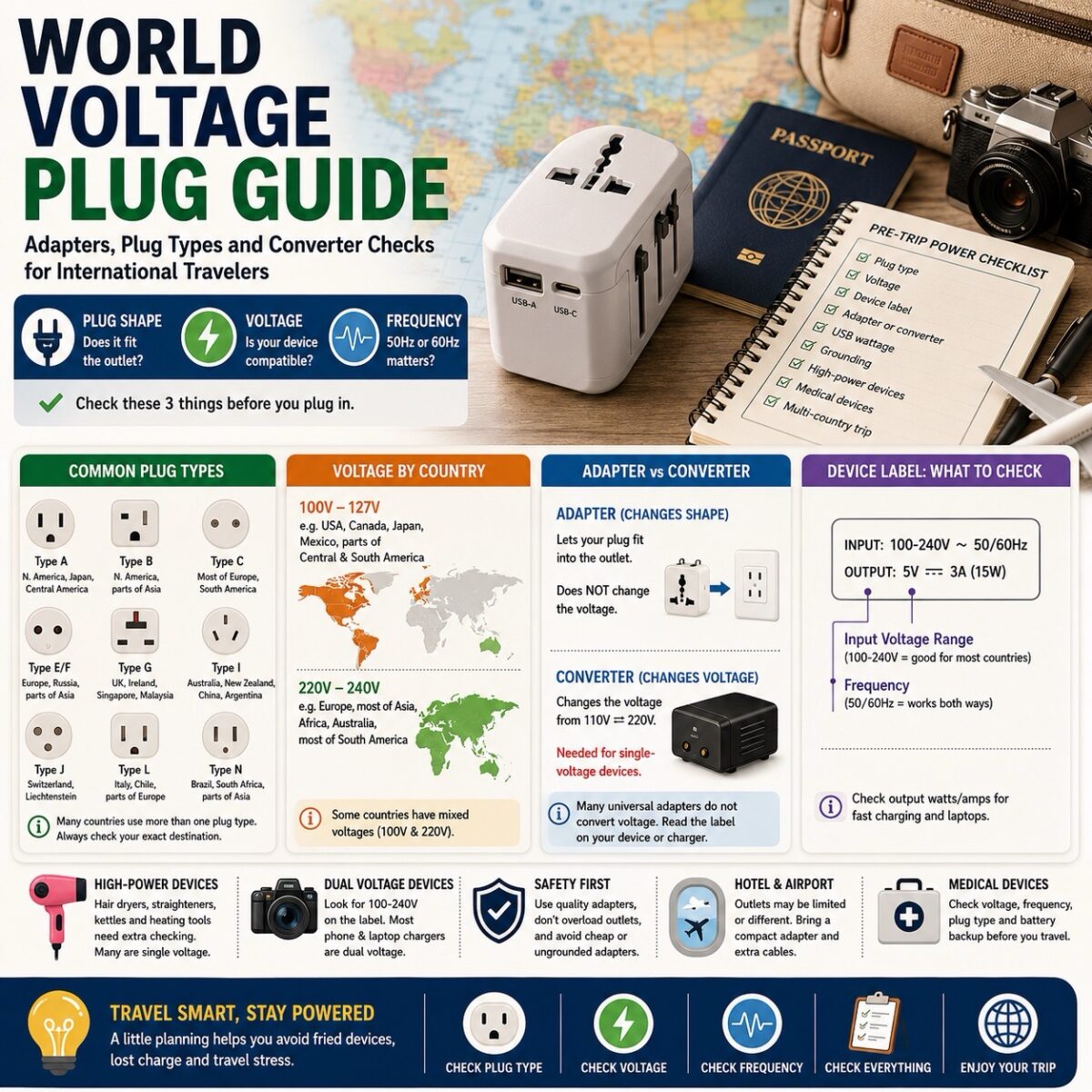
Power outlets abroad are confusing because plug shape and voltage are separate questions. A charger may fit the wall with an adapter, but it still needs to support the local voltage before it is safe to use.
This world voltage plug guide explains what international travelers should check before packing phone chargers, laptops, cameras, hair tools, electric shavers, CPAP machines, and other travel electronics. The goal is not to memorize every socket in the world. It is to know whether you need a plug adapter, a voltage converter, or a safer device choice before you plug anything in.
Quick answer: check three things before using electronics abroad: the destination’s plug type, the local voltage and frequency, and the input label on your charger or device. A plug adapter changes shape, but it does not automatically change voltage.
What this world voltage plug guide helps you check
The first thing to check is the plug type. This is the shape of the outlet and the pins. A device from the United States may not physically fit into a wall outlet in the United Kingdom, South Korea, Italy, Australia, or Switzerland without an adapter. Even within one region, plug shapes can vary by country.
The second thing to check is voltage. Many phone and laptop chargers are designed for international use, but not every device is. Hair dryers, curling irons, electric kettles, some shavers, and older appliances may be single-voltage. If a single-voltage device is plugged into the wrong voltage, it may overheat, fail, or become unsafe.
The third thing to check is frequency and grounding. Most modern chargers handle both 50Hz and 60Hz, but some motors, clocks, and appliances may care. Grounded devices also need a compatible grounded adapter, not just any cheap two-pin plug shape. For broader destination planning, keep LnJGuide country travel guides open while checking local plug and voltage information.
Plug adapter vs voltage converter: the key difference
A plug adapter changes the shape of the plug so it can fit into a different outlet. It does not change the electricity coming from the wall. If the local outlet provides 230V, a basic plug adapter still provides 230V to your device.
A voltage converter or transformer changes voltage. This is what matters when a device is designed only for one voltage range, such as 110–120V, and you want to use it in a 220–240V destination. The problem is that converters are not always suitable for every appliance, especially high-power heat devices.
This is why universal travel adapters can be misunderstood. A universal adapter may include several plug shapes in one compact device, but many universal adapters do not convert voltage. They only help the plug fit. Some also include USB ports, but those ports have their own output limits for charging phones, tablets, or small electronics.
Traveler mistake to avoid: do not assume “universal adapter” means “safe for every device.” Always read the input label on the device or charger before plugging it into an outlet abroad.
How to read your charger label before travel
The most useful label is usually printed on the charger brick, power supply, or device body. Look for the word “Input.” A travel-friendly charger often says something like “Input: 100–240V, 50/60Hz.” This means the charger can usually accept common voltages and frequencies used in many countries.
If the label says only “Input: 120V” or only “Input: 230V,” treat it as a single-voltage device. A plug adapter alone is not enough when the destination voltage does not match. You may need a converter, a different charger, or a locally compatible device.
Also check the output rating, especially for USB chargers. A charger may technically work abroad but charge slowly if the wattage is too low for your phone, tablet, or laptop. For USB-C laptops, tablets, and fast-charging phones, check whether the charger supports enough watts for your device.
Where to find the label
For phone and laptop chargers, the label is usually on the charging brick. For camera battery chargers, it may be on the back or bottom. For electric shavers, toothbrush chargers, hair tools, and medical devices, it may be printed on the device, charging base, adapter, or manual.
If the text is tiny, take a photo and zoom in before the trip. Do this at home, not in a hotel bathroom when you are already trying to get ready. If you cannot find the rating, search the official manual or manufacturer’s specification for the exact model.
Common plug types travelers see abroad
The world uses several plug and socket types. You do not need to memorize all of them, but it helps to recognize the common travel patterns. Type A and Type B are used in places such as the United States, Canada, Japan, Mexico, and parts of Central and South America. Type C and Type F are common across much of Europe and parts of Asia. Type G is used in the United Kingdom, Ireland, Singapore, Malaysia, and several other destinations.
Type I is common in Australia, New Zealand, China, and some Pacific destinations. Type J is used in Switzerland and Liechtenstein. Type L appears in Italy and some other places. Type N is used in Brazil and South Africa, among others. Some countries use more than one plug type, so checking only the region is not enough.
Hotels can add another layer of confusion. Some hotels offer universal sockets, USB outlets, or mixed outlet panels near the desk. These can be convenient, but they do not remove the need to check voltage and device rating. A socket that accepts your plug shape does not automatically mean the electricity is safe for every device.
Voltage by country: why 110V, 120V, 220V and 230V matter
Voltage tells you the electrical pressure supplied by the outlet. Many destinations use around 220–240V. Others use around 100–127V. Some countries have mixed systems, older buildings, hotel-specific outlets, or special bathroom shaver outlets.
For modern phone, tablet, laptop, camera, and USB chargers, the input label often shows 100–240V. If it does, a plug adapter may be enough for many normal charging situations. But high-power appliances are different, especially anything that heats, spins, or draws a lot of power.
Hair dryers, curling irons, straighteners, travel kettles, steamers, and heating tools are the devices that cause the most trouble. They use more power than phone chargers, and many are not designed for international voltage. Even when a converter exists, using a high-power heat device through the wrong converter can be risky.
If you travel often, a dual-voltage hair tool or a locally provided hotel appliance may be safer than packing a single-voltage device. If your hotel provides a hair dryer, use that rather than forcing a home appliance into an unfamiliar outlet. If you must bring a device, check the label carefully and confirm the adapter or converter can handle the wattage.
Devices that usually need extra checking
Some travel electronics are simple. Others need a closer look before the trip. The more important or powerful the device is, the less you should guess.
- Hair dryers, straighteners and curling irons: check voltage and wattage carefully because heat devices draw a lot of power.
- Electric toothbrushes and shavers: check the charging base label, not only the handle.
- CPAP and medical devices: check voltage, frequency, battery backup, plug type and airline or hotel power needs before departure.
- Camera battery chargers: many are dual voltage, but you should still read the input label.
- Game consoles and larger electronics: check the power supply label and do not assume every model is identical worldwide.
- Power strips and extension cords: avoid overloading a small travel adapter with several devices at once.
Medical devices deserve special attention. If you use a CPAP machine, nebulizer, mobility device charger, or other essential equipment, check the official manual and consider contacting the manufacturer before travel. Also ask the hotel whether the room has a suitable outlet near the bed if the device must run overnight.
Frequency: when 50Hz and 60Hz matter
Frequency is measured in hertz, usually 50Hz or 60Hz. Many modern chargers are labeled 50/60Hz, which means they can handle both common frequencies. This is why phone chargers and laptop chargers often work internationally when the voltage range is also correct.
Frequency can matter more for devices with motors, timing mechanisms, clocks, pumps, or some older appliances. A device may turn on but run at the wrong speed, heat differently, or not perform as expected. If the device label does not include the destination frequency, do not assume it is fine.
For most travelers, frequency is a “read the label” issue rather than a calculation issue. If the label says 100–240V and 50/60Hz, the device is usually designed for common international electrical systems. If it does not, check the manufacturer’s information before packing it.
Grounding, three-pin plugs and safety
Grounding is easy to ignore until you have a three-pin device and a two-pin adapter. A grounded plug is designed with an extra safety path. If you use an adapter that removes grounding, the device may fit the wall but lose part of its intended safety design.
This matters for laptops with grounded power bricks, some medical devices, large chargers, and appliances with metal bodies. If a device has a grounded plug, use a grounded adapter that matches the destination’s socket type. Do not break off pins, force plugs, or stack several cheap adapters together.
Also be careful with power strips. Plugging a multi-outlet strip into a small travel adapter can overload the adapter or wall outlet, especially if you connect high-power devices. For normal travel, it is usually safer to use a quality adapter with a few built-in USB ports and charge devices in shifts.
Safety warning: if an outlet is loose, sparks, smells hot, discolors, or makes a device unusually warm, stop using it. Ask the hotel or host for another outlet instead of forcing the setup.
Hotel, airport and cruise outlet surprises
Hotels often make power easier, but not always. A room may have one international socket near the desk, local sockets near the bed, USB-only outlets, or a bathroom shaver outlet with limited power. USB outlets can be convenient, but they may charge slowly or may not support newer fast-charging devices.
Older buildings can have loose outlets, limited grounding, or fewer sockets than expected. If you are traveling with several devices, prioritize what must charge overnight and what can wait. Do not plug several high-power items into one adapter just because the adapter has multiple openings.
Airports, trains, buses, and lounges may offer USB ports or local outlets, but the same rule applies: plug shape is not the whole story. Public USB ports may charge slowly, and you may need your own cable or charger. A compact adapter is useful during layovers if your route includes more than one plug type.
Cruise ships can have special restrictions on power strips, extension cords, heating tools, and surge protectors. If you are traveling by cruise, check the cruise line’s prohibited-items and electrical-device policy before packing.
Common power plug mistakes travelers make
- Buying only a plug adapter for a single-voltage appliance. A shape adapter does not change voltage.
- Assuming a universal adapter is also a converter. Many universal adapters only change plug shape.
- Packing high-power hair tools without checking wattage. Heat devices are one of the riskiest travel electronics categories.
- Ignoring the input label. The label on the charger or device tells you more than the plug shape does.
- Forgetting grounding. A three-pin grounded device should use a compatible grounded adapter.
- Overloading one adapter. Multiple sockets do not mean unlimited power.
- Forgetting multi-country routes. A layover, cruise, or multi-country itinerary may require more than one plug type.
- Not checking medical-device power needs. Essential devices should be verified before departure, not after hotel check-in.
Pre-trip power checklist
- Check the destination plug type. Use a reliable plug and voltage source for your country or countries.
- Check local voltage and frequency. Look for 100–127V or 220–240V, plus 50Hz or 60Hz.
- Read every device label. Look for input such as 100–240V, 50/60Hz.
- Separate adapters from converters. A plug adapter changes shape; a converter changes voltage.
- Check high-power appliances. Hair tools, steamers and kettles need extra attention.
- Check USB wattage. Make sure your charger can support phones, tablets, laptops or cameras at the speed you need.
- Keep grounding in mind. Use grounded adapters for grounded devices.
- Plan for medical devices. Confirm voltage, frequency, plug type, battery backup and outlet location.
- Pack for the full route. Check layovers, cruise cabins and every country on a multi-country itinerary.
A world voltage plug guide cannot replace checking your exact destination and device label, but it can help you avoid the most common mistake: thinking that a plug adapter solves everything. Shape, voltage, frequency and grounding are separate checks.
The safest travel habit is simple. Read the label first, match the plug shape second, and avoid using high-power devices unless you are sure they are compatible. If the label is unclear, do not guess with electricity.
Sources and official references:
FAQ
What is the difference between a travel adapter and a voltage converter?
A travel adapter changes the plug shape so your device can fit a foreign outlet. A voltage converter changes the voltage. Many travelers only need a plug adapter for dual-voltage chargers, but single-voltage appliances may need a converter or should not be used abroad.
Do I need a converter if my charger says 100–240V?
Usually not for normal charging, as long as the charger also supports the local frequency and you have the correct plug adapter. A label such as 100–240V, 50/60Hz usually means the charger is designed for common international electrical systems.
Can I use my hair dryer abroad?
Only if the hair dryer supports the destination voltage or you have a suitable converter rated for the device’s wattage. Hair dryers and styling tools draw a lot of power, so a basic plug adapter is not enough for a single-voltage device.
Are universal travel adapters safe?
They can be useful, but they are not all the same. Many universal adapters do not convert voltage, and some are not grounded or not suitable for high-power appliances. Check the adapter rating and your device label before use.
What does 50/60Hz mean on a charger?
50/60Hz means the charger can usually work with both common electrical frequencies. Many modern phone and laptop chargers support both. Frequency can matter more for motors, clocks, pumps and some older appliances.
Can I plug a power strip into a travel adapter?
Be careful. Plugging several devices into one small adapter can overload it, especially if any device uses heat or high power. If you use a power strip, check voltage, grounding, plug type, and total wattage carefully.
What plug adapter do I need for Europe?
Many European countries use Type C, Type E or Type F style plugs, but Europe is not one single plug system. The United Kingdom, Ireland, Switzerland, Italy and some other destinations may use different plug types, so check the exact country before travel.
What should I check for CPAP or medical devices?
Check the device input label, voltage, frequency, plug type, grounding, battery backup and whether you need an outlet near the bed. For essential medical devices, confirm the details with the manufacturer or manual before departure.