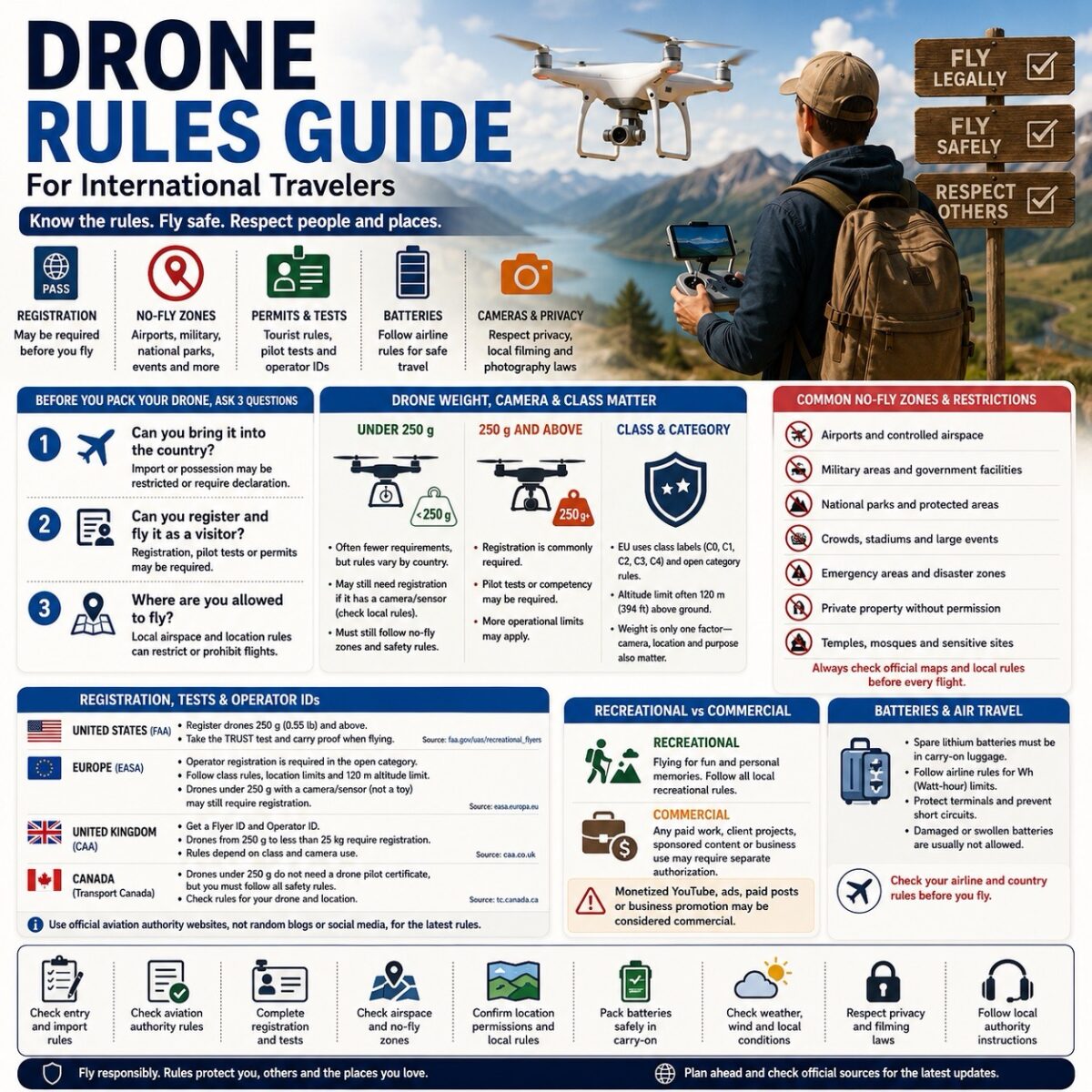
Drone rules can change the moment you cross a border. A drone that is easy to fly at home may need registration, pilot training, a permit, or a no-fly zone check before you can legally use it abroad.
This drone rules guide explains what international travelers should check before packing, entering a country with, or flying a drone on a trip. The important point is simple: bringing a drone into a country and flying it legally are two different questions.
Quick answer: before traveling with a drone, check the destination’s official aviation authority, drone registration rules, pilot test or operator ID requirements, no-fly zones, local filming restrictions, recreational versus commercial rules, and airline battery rules.
What this drone rules guide helps you check
Drone travel is not only about the drone itself. It involves customs, aviation law, local airspace, privacy rules, national parks, religious or cultural sites, emergency areas, and battery packing. A small camera drone can still create legal problems if it is flown in the wrong place.
The first question is whether you can bring the drone into the country. Some destinations allow tourists to enter with a drone for personal use. Others may require declaration, import approval, temporary permission, or may restrict drones more strongly at the border.
The second question is whether you can register and fly it as a visitor. Some countries allow foreign visitors to register online. Others may require a local address, pilot competency proof, local sponsor, or permit before flying. A rule that works for residents may not work the same way for tourists.
The third question is where you are allowed to fly. A drone may be registered correctly and still be illegal to fly near airports, military areas, government buildings, crowds, national parks, city centers, beaches, temples, heritage sites, disaster zones, or temporary restricted areas. For broader destination planning, keep LnJGuide country travel guides open while checking local drone and travel rules.
Start with three questions before packing a drone
Before you put a drone in your bag, answer three practical questions. First, is drone import, possession, or entry restricted in the destination country? Second, is tourist or recreational flying allowed? Third, is your planned location legal to fly in?
These questions sound similar, but they are different. A country may allow you to bring a drone through the airport but limit where it can be used. Another destination may allow recreational flying but require registration before the first flight. A scenic location may look perfect for aerial video but be inside a national park, airport control zone, military area, or local no-drone zone.
Do not rely only on old travel forum posts, social media videos, or the fact that other tourists have flown there. Drone enforcement can change quickly, and a place that was loosely controlled last year may be restricted now. Always look for the official aviation authority, government portal, or approved airspace tool for the destination.
Drone weight, camera and class matter
Drone weight is one of the first things many rules look at, but weight alone is not enough. Some countries use thresholds such as under 250 g, 250 g and above, 900 g and above, or 25 kg and above. Others combine weight with drone class, camera use, remote ID, pilot competency, and operating category.
A common mistake is assuming that a drone under 250 g is automatically free to fly everywhere. That is not true. A sub-250 g drone may have fewer requirements in some countries, but it may still be restricted if it has a camera, if it is flown near people, if it enters controlled airspace, or if the location itself prohibits drones.
Camera drones can also trigger separate rules. A small drone with a camera may be treated differently from a toy drone with no camera or sensor. Privacy, filming, and local security rules may apply even when aviation registration is not required.
EU, UK, U.S. and Canada examples show why weight is only the start
In the European Union’s open category, drone operations are organized by risk, class and weight, with rules around altitude, people, operator registration, and remote pilot competency. Some light drones may still require operator registration if they have a camera or sensor and are not treated as toys.
In the United Kingdom, registration and flyer requirements can depend on weight, class, and camera use. In the United States, recreational flyers must check registration and training requirements, including rules for drones at or above certain weight thresholds. In Canada, drones under 250 g are treated differently from heavier drones, but pilots are still expected to fly safely and avoid prohibited situations.
The lesson is not that one country’s number applies everywhere. The lesson is that every destination has its own combination of weight, camera, purpose, location, and pilot requirement.
Registration, pilot tests and operator IDs
Many countries now require some form of drone registration, pilot education, or operator identification before flying. The name of the requirement changes by country. You may see terms such as drone registration, operator ID, flyer ID, remote pilot certificate, competency test, trust test, permit, authorization, or declaration.
Registration may apply to the drone, the operator, or both. A pilot test may be required even for recreational flights. Some systems are quick and online, while others may take longer or may not be designed for short-term visitors. Do this check before the trip, not the night before you plan to fly.
Check whether the official system accepts foreign pilots. Some countries let tourists register before arrival. Others may require a local phone number, local address, local ID, or a separate visitor permit. If the process is unclear, contact the aviation authority, destination tourism office, or a licensed local drone operator before assuming you can fly.
Be careful with unofficial drone license websites. Some sites look official but charge extra fees or provide documents that are not recognized by the aviation authority. Use the official civil aviation regulator, government drone portal, or links from an official tourism or aviation website.
No-fly zones and restricted airspace
No-fly zones are one of the most important parts of drone travel. Even if your drone is registered and your pilot test is complete, the location may still be restricted. Airports, helipads, military areas, government buildings, prisons, emergency sites, disaster zones, and major event areas are common places where drone flying may be prohibited or require authorization.
Tourist locations also need careful checking. Beaches, city viewpoints, national parks, temples, historic sites, stadiums, festivals, and crowded squares may look perfect for aerial footage, but local authorities may restrict drones for safety, privacy, wildlife, cultural, or security reasons.
Do not rely only on the drone app or built-in geofencing. Drone apps can be useful, but they may not show every local rule, temporary restriction, park rule, private-property restriction, or filming permit requirement. Always compare app information with official airspace maps, aviation authority guidance, local signs, and staff instructions at the site.
Important warning: if police, airport staff, park rangers, security guards, or site staff tell you not to fly, land immediately and follow the instruction. Arguing that your app allowed the flight usually will not help.
Recreational vs commercial drone flying
Many travelers think of drone flying as recreational because they are filming their own trip. That may be true in many situations, but the line can become less clear when the flight is connected to paid work, client footage, real estate, tours, brand content, monetized channels, sponsored posts, or business promotion.
Commercial or work-related drone flying often has stricter requirements than recreational flying. It may require a pilot certificate, operational authorization, insurance, local permit, or permission from the site owner. A small drone does not automatically make commercial filming legal.
If you plan to use drone footage for business, paid content, client work, or a monetized project, check the destination’s commercial drone rules before the trip. It is much safer to confirm in advance than to discover after arrival that the flight requires approval you cannot obtain quickly.
Drone batteries and airport packing
Drone travel also involves battery rules. Most consumer drones use lithium batteries, and spare lithium batteries are usually handled more carefully than normal electronics. Airlines and airport security may require spare batteries to be carried in hand baggage, protected from short circuits, and kept within capacity limits.
Check the Wh rating on each drone battery. If the battery label is unclear, check the manufacturer’s specification before the trip. Larger batteries may require airline approval, and damaged or swollen batteries should not be packed for air travel.
Keep spare batteries in protective cases, original packaging, or separate battery bags. Do not leave loose battery terminals touching keys, coins, tools, or cables. If you carry multiple drone batteries, keep them organized so airport staff can inspect them without you unpacking your entire bag.
Camera, privacy and local filming rules
Aviation approval does not automatically mean filming is allowed. Camera drones can raise privacy, security, cultural, and site-permission issues. Flying over people, private homes, hotel pools, beaches, religious sites, schools, government buildings, or private events can create problems even if the airspace itself is not obviously restricted.
Some destinations have separate rules for filming people, filming in public areas, filming inside heritage sites, or publishing footage online. National parks, museums, temples, archaeological areas, and private resorts may also have their own filming policies. Always check signs and ask staff before flying in managed sites.
Be especially careful around people who did not agree to be filmed. A drone can feel more intrusive than a handheld camera because it moves overhead, records from a distance, and attracts attention. Respecting privacy is part of responsible flying, not just a legal detail.
Common drone mistakes travelers make
- Checking only airline battery rules. Battery approval does not mean flight permission exists at the destination.
- Assuming sub-250 g drones are always allowed. Small drones may still need registration, operator ID, or location permission.
- Relying only on drone app geofencing. Apps may not show every local rule, temporary restriction, or park policy.
- Flying near airports or helipads. Controlled airspace is one of the most serious drone-rule areas.
- Ignoring national park or heritage-site rules. Local site rules can prohibit drones even when general aviation rules allow them elsewhere.
- Forgetting registration before arrival. Some systems take time or may not work easily for short-term visitors.
- Using drone footage for paid work without checking. Commercial or monetized use may require separate authorization.
- Flying over people or crowds. Many drone rules restrict flights over uninvolved people or assemblies.
- Ignoring privacy and filming concerns. A legal flight can still be disrespectful or restricted by local filming rules.
Pre-flight drone checklist for international trips
- Check entry rules. Confirm whether you can bring the drone into the destination country.
- Find the official aviation authority. Use government or civil aviation regulator websites, not random forum posts.
- Confirm registration requirements. Check whether the drone, operator, or pilot must be registered.
- Complete pilot tests or IDs. Look for recreational tests, flyer IDs, operator IDs, competency proof, or permits.
- Check airspace and no-fly zones. Use official maps or approved tools before every flight.
- Check the exact location. National parks, temples, beaches, events, and city centers may have their own drone rules.
- Review privacy and camera rules. Do not film people, private property, or sensitive sites without checking local expectations.
- Pack batteries safely. Carry spare lithium batteries correctly, protect terminals, and check Wh limits.
- Watch weather and wind. Coastal areas, mountains, islands, and city canyons can change drone handling quickly.
- Respect local instructions. Land immediately if officials, staff, or site managers tell you not to fly.
A drone rules guide cannot replace official country-specific rules, because drone regulations change often and depend on your exact drone, purpose, and flight location. But it can help you ask the right questions before the drone ever leaves your bag.
The safest approach is to plan every flight as if you need three kinds of permission: permission to bring the drone, permission to operate it, and permission to fly in that specific location. If any one of those is unclear, check again before takeoff.
Sources and official references:
FAQ
Can I bring a drone on an international trip?
Sometimes, but you should check the destination country before packing it. Some countries allow tourist drones, while others may require declaration, import approval, temporary permission, or may restrict drones at the border. Bringing a drone and flying it legally are separate questions.
Do I need to register a drone before flying abroad?
In many countries, yes. Registration may apply to the drone, the operator, or the pilot. Some destinations also require a pilot test, operator ID, flyer ID, permit, or competency proof. Always check the official aviation authority before flying.
Are drones under 250 g always allowed?
No. Drones under 250 g may have fewer requirements in some countries, but they are not automatically allowed everywhere. Camera use, no-fly zones, crowds, national parks, airports, privacy rules, and local site rules may still restrict the flight.
Can tourists fly drones in national parks?
Do not assume so. Many national parks, protected areas, heritage sites, temples, and wildlife areas restrict or prohibit drones, even when general aviation rules allow drone flying elsewhere. Check the park or site authority before flying.
Can I fly a drone near airports?
Usually not without proper authorization. Airports, helipads, controlled airspace, and approach paths are among the most sensitive drone areas. Use official airspace tools and aviation authority guidance before flying anywhere near an airport.
Are drone batteries allowed in carry-on luggage?
Drone batteries are usually lithium batteries, so airline and airport battery rules apply. Spare batteries are commonly carried in hand baggage, with terminals protected from short circuits. Check Wh ratings and airline approval rules before travel.
Is YouTube or social media drone filming commercial?
It depends on the country and how the footage is used. Personal travel memories may be treated differently from paid work, client projects, sponsored posts, monetized channels, or business promotion. If the footage has a commercial purpose, check commercial drone rules before flying.
Where should I check official drone rules?
Start with the destination country’s civil aviation authority or official drone portal. For location-specific rules, check official airspace maps, national park or site rules, local government notices, and instructions from police, park rangers, airport staff, or site managers.