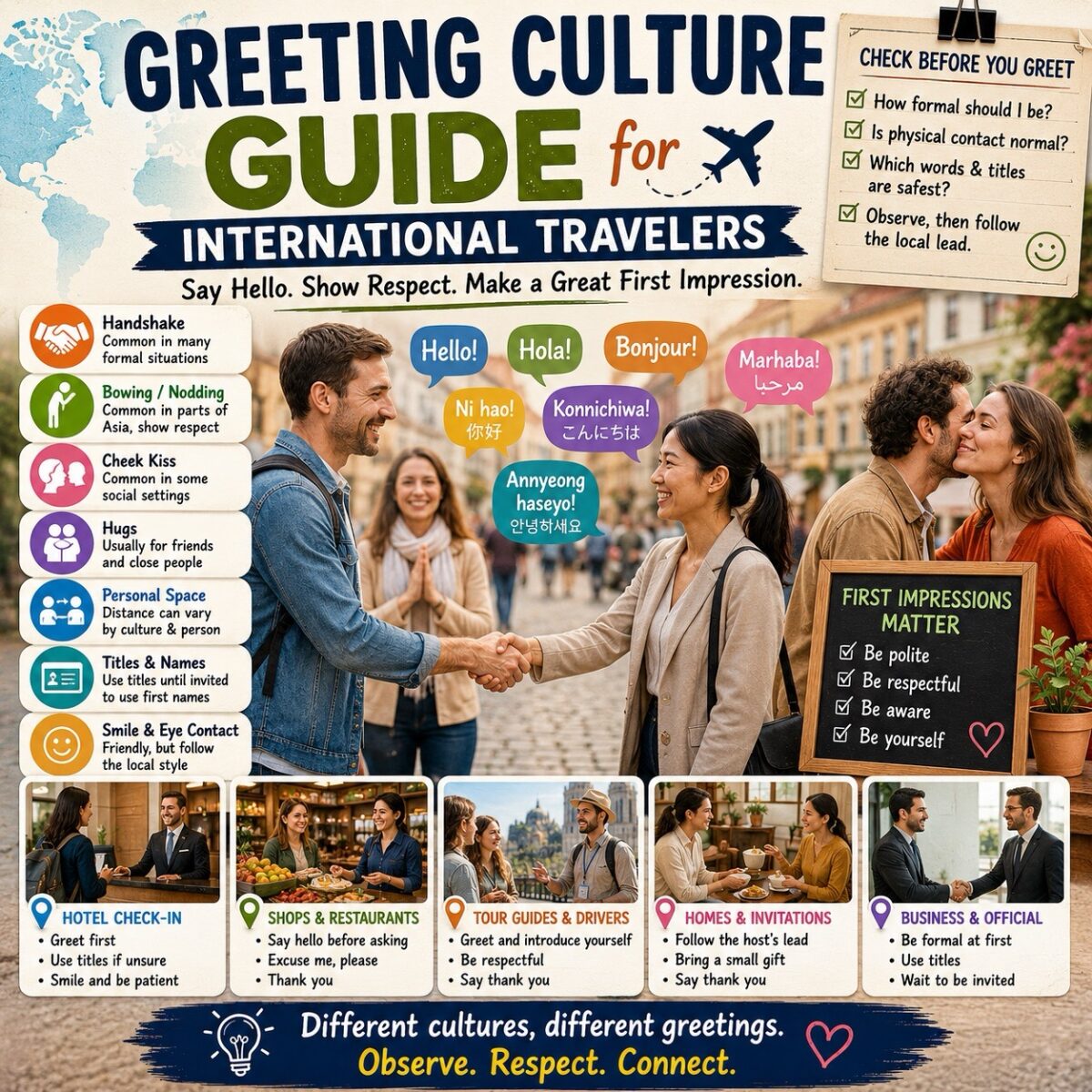
Greeting culture can shape the first few seconds of a trip. A handshake, bow, cheek kiss, hug, or simple verbal hello may feel polite in one country and too familiar, too distant, or too formal in another.
This greeting culture guide explains what international travelers should check before meeting hotel staff, restaurant workers, tour guides, hosts, business contacts, or local friends abroad. The goal is not to copy every greeting perfectly. It is to start respectfully, read the situation, and avoid making the first moment uncomfortable.
Quick answer: when you are unsure how to greet someone abroad, start with a polite verbal greeting, keep physical contact minimal, use titles or formal language when appropriate, and follow the other person’s lead.
What this greeting culture guide helps you check
Greetings are small, but they carry a lot of cultural information. They can show respect, warmth, distance, friendliness, age awareness, religious sensitivity, or professional formality. This is why the same gesture can feel natural in one place and awkward in another.
The first thing to check is formality. Are first meetings usually casual, or do people begin with titles, surnames, or polite language? Do hotel staff, guides, hosts, or business contacts expect a more formal tone than friends of friends?
The second thing to check is physical contact. In some places, a handshake is common. In others, a bow, nod, smile, or verbal greeting may be safer. Cheek kisses and hugs can be normal in some social settings, but they usually depend on relationship, gender, age, region, and personal comfort.
The third thing to check is the greeting phrase. Learning even one local “hello,” “thank you,” or “excuse me” can soften the first interaction. For broader destination planning, keep LnJGuide country travel guides open while checking local customs and travel basics.
Start with a verbal greeting before asking for help
One of the easiest greeting mistakes is asking a question too quickly. A traveler walks into a shop, hotel, train station, or restaurant and immediately says, “Where is the bathroom?” or “Do you speak English?” In many places, starting with a simple hello first feels more respectful.
A short greeting gives the other person a moment to respond. “Hello,” “Good morning,” “Excuse me,” or the local equivalent can make a practical question feel less abrupt. You do not need perfect pronunciation. A small effort is usually better than skipping the greeting entirely.
This matters most in everyday travel moments: checking in at a hotel, entering a small shop, asking a waiter for a table, meeting a tour guide, speaking to a ticket-counter worker, or asking someone for directions. The greeting does not have to be long. It just needs to come before the request.
Learn a few local greeting words
For most trips, you do not need to speak the local language fluently to greet people politely. Start with five phrases: hello, good morning, excuse me, please, and thank you. These are small words, but they carry a lot of goodwill when you are a visitor.
In multilingual destinations, locals may use several greeting styles depending on language, setting, and the person they are speaking to. A hotel desk may use English with visitors, while a market vendor may respond better to a simple local greeting. If you are unsure, smile, say hello clearly, and adapt after the other person responds.
Handshake, bow, cheek kiss or hug?
The hardest part of greeting culture is often the gesture. Should you offer a hand? Bow? Lean in for a cheek kiss? Wait? The safest travel rule is to begin slightly more formal than you think you need to be, then soften if the other person does.
Handshakes are common in many formal, business, and first-meeting settings, but they are not universal. A handshake can feel normal in one place, too formal in another, and too much physical contact in some situations. If you offer a handshake and the other person responds differently, adjust without making a big reaction.
Bowing or nodding can be a respectful greeting in several East Asian contexts. Japan’s official tourism guidance notes that a courteous nod or bow when greeting someone or entering and leaving an establishment can go a long way. In Korea, a small bow or respectful nod can also be part of polite everyday interaction.
Cheek kisses and hugs depend on relationship
Cheek kisses are common in some social settings, especially among people who know each other or are introduced through friends. But they are not universal, and the number of cheek kisses can vary by country, region, and social group. A visitor should not rush into this gesture without reading the room.
Hugs usually require more familiarity. They may be normal among close friends or family, but too personal for a first meeting, hotel interaction, restaurant visit, or business introduction. If the other person opens their arms or clearly initiates the gesture, you can respond naturally. If not, a smile, nod, or verbal greeting is safer.
Personal space and physical contact abroad
Personal space is one of the quietest parts of greeting culture. People rarely explain it out loud, but they notice when someone stands too close, touches too quickly, or steps back too abruptly. Distance can vary by country, city, relationship, age, and personality.
When meeting someone for the first time, keep a little space and avoid touching arms, shoulders, backs, or faces unless the local setting clearly supports that kind of contact. This is especially important when meeting older people, religious hosts, business contacts, hotel staff, or anyone in a professional role.
Post-pandemic comfort levels can also affect greetings. Some people returned to handshakes and hugs quickly, while others still prefer less contact. This may not be about you personally. It may be health, habit, age, workplace policy, or personal preference.
Gender and religious context can also matter. In some settings, people may avoid handshakes or close physical greetings with the opposite gender. If you are unsure, wait for the other person to initiate contact. A hand over the heart, a nod, or a verbal greeting can often feel respectful without forcing physical contact.
Titles, first names and levels of formality
Names are another part of greeting culture that travelers often rush through. In some countries and social groups, first names are used quickly. In others, titles, surnames, professional roles, or age-based respect are important at first meetings.
If you are meeting hotel staff, officials, teachers, hosts, business contacts, or older people, start slightly formal. Use Mr., Ms., Dr., Professor, or the local title if you know it. If the person invites you to use a first name, you can switch. Waiting for that invitation is usually safer than becoming too casual too quickly.
In casual travel settings, such as hostel common rooms, walking tours, language exchanges, or meeting other travelers, first names may be normal right away. But when you are unsure, a polite greeting plus a simple introduction works almost everywhere: “Hello, my name is…” is rarely a bad start.
Eye contact, smiling and body language
Eye contact can signal attention and confidence, but the comfortable amount varies. In some places, steady eye contact feels honest and friendly. In others, too much direct eye contact may feel intense, especially with older people, officials, or strangers.
Smiling can help soften a greeting, but it is not a complete substitute for politeness. A smile without a hello may still feel abrupt in places where verbal greetings matter. On the other hand, a big smile, loud voice, and strong handshake may feel like too much in a more reserved setting.
Keep gestures simple until you know local meanings. Pointing, beckoning with a finger, touching someone’s head, putting hands in pockets during a formal greeting, or using a casual wave may have different meanings by culture. If you do not know the local gesture, use a small nod, open posture, and polite words.
Greeting etiquette in common travel situations
Hotel check-in
Hotel check-in is usually a safe place to be polite and slightly formal. Say hello, give your name, and wait for staff to ask for documents or booking details. If there is a problem with the room, payment, or reservation, keeping the greeting calm and respectful can make the conversation easier.
Small shops and restaurants
In many places, entering a small shop, bakery, cafe, or restaurant without greeting staff can feel cold. A quick hello before asking for a table, menu, size, price, or bathroom is a simple habit that helps. If staff greet you first, respond before moving into your question.
Tour guides and drivers
A tour guide, private driver, or local host may spend several hours with you, so the first greeting sets the tone. Introduce yourself, use the name they give you, and ask how they prefer to be addressed if you are unsure. A friendly but not overly familiar greeting is usually best.
Homes, homestays and local invitations
When entering someone’s home, be more careful than in a shop or hotel. Watch the host’s lead. Shoes, seating, gifts, greetings to older family members, and the order of introductions can matter. A small respectful pause at the doorway is better than rushing in as if it were a public place.
Business or official settings
Business greetings are usually more formal than tourist interactions. Use titles if you know them, avoid overly casual jokes at the first moment, and wait before using first names. A handshake may be common in many business cultures, but not all, so watch what the host or senior person does first.
Common greeting mistakes travelers make
- Asking a question without saying hello. A simple greeting can make the same request sound much more polite.
- Hugging too quickly. Hugs usually require familiarity and may feel too personal for a first meeting.
- Forcing a handshake. Some people avoid handshakes for health, religious, gender, or personal reasons.
- Using first names too soon. Titles or surnames may be safer until invited otherwise.
- Overdoing a local gesture. A dramatic bow, exaggerated accent, or forced phrase can feel less respectful than a simple polite greeting.
- Ignoring personal space. Standing too close or touching casually can make a first interaction uncomfortable.
- Assuming everyone in one country greets the same way. Age, region, formality, relationship, and personality all matter.
- Speaking louder when language is difficult. A slower voice, simple words, and polite greeting usually work better than extra volume.
Simple greeting checklist before your first interaction
- Learn a local hello. Add thank you, excuse me, and good morning if you can.
- Start slightly formal. It is easier to become more casual than to repair a greeting that felt too familiar.
- Say hello before asking. This helps in shops, hotels, restaurants, stations, and tours.
- Watch physical contact. Handshakes, bows, cheek kisses, and hugs depend on setting and relationship.
- Respect personal space. Stand at a comfortable distance and avoid unnecessary touching.
- Use titles when unsure. Switch to first names when invited.
- Follow the local person’s lead. Match the level of formality rather than forcing your own habit.
- Keep gestures simple. A nod, smile, and polite words are safer than unfamiliar hand gestures.
- Recover gently from mistakes. Smile, apologize briefly, and adjust without making the moment bigger.
A greeting culture guide cannot tell you exactly how every person in every country wants to be greeted. But it can help you choose a safer starting point. Say hello first, stay slightly formal, watch the other person, and adapt to the setting.
The best greeting is not always the most local-looking one. It is the one that shows respect without forcing closeness. When in doubt, observe, pause, greet politely, and let the conversation begin from there.
Sources and official references:
FAQ
What is greeting culture?
Greeting culture is the way people say hello, show respect, use names, manage physical contact, and begin social or professional interactions. It can include words, bows, handshakes, cheek kisses, hugs, personal space, titles, and body language.
How should I greet people when traveling abroad?
Start with a polite verbal greeting and keep your body language calm. If you are unsure, avoid strong physical contact at first, use a slightly formal tone, and follow the other person’s lead. A simple hello and respectful pause are usually safer than guessing a gesture too quickly.
Is it better to shake hands or bow?
It depends on the country, setting, and person. Handshakes are common in many formal or business situations, while bows or nods are common in some East Asian contexts. When unsure, wait to see what the other person does or use a polite verbal greeting with a small nod.
Are cheek kisses normal everywhere?
No. Cheek kisses are common in some social settings and uncommon in others. They may depend on region, relationship, gender, age, and formality. Travelers should not initiate cheek kisses unless the setting clearly suggests it or the other person begins the gesture.
Should I hug people when meeting them abroad?
Usually not at a first meeting unless the relationship is already close or the other person clearly initiates it. Hugs can feel warm in some cultures and too personal in others. For hotels, restaurants, tours, shops, and business settings, a verbal greeting, nod, or handshake is usually safer.
Should I use first names or titles?
Use titles, surnames, or a more formal greeting when you are unsure, especially with older people, hosts, officials, teachers, business contacts, or professional settings. If the person invites you to use a first name, you can switch.
What local greeting phrases should travelers learn?
Learn hello, good morning, excuse me, please, and thank you. These phrases are useful in hotels, restaurants, shops, taxis, train stations, markets, and tours. Pronunciation does not need to be perfect; the effort itself often makes the interaction warmer.
What should I do if I make a greeting mistake?
Do not overreact. Smile, apologize briefly if needed, and adjust to the other person’s response. Most people understand that travelers may not know every custom, especially when the mistake is small and the intention is respectful.