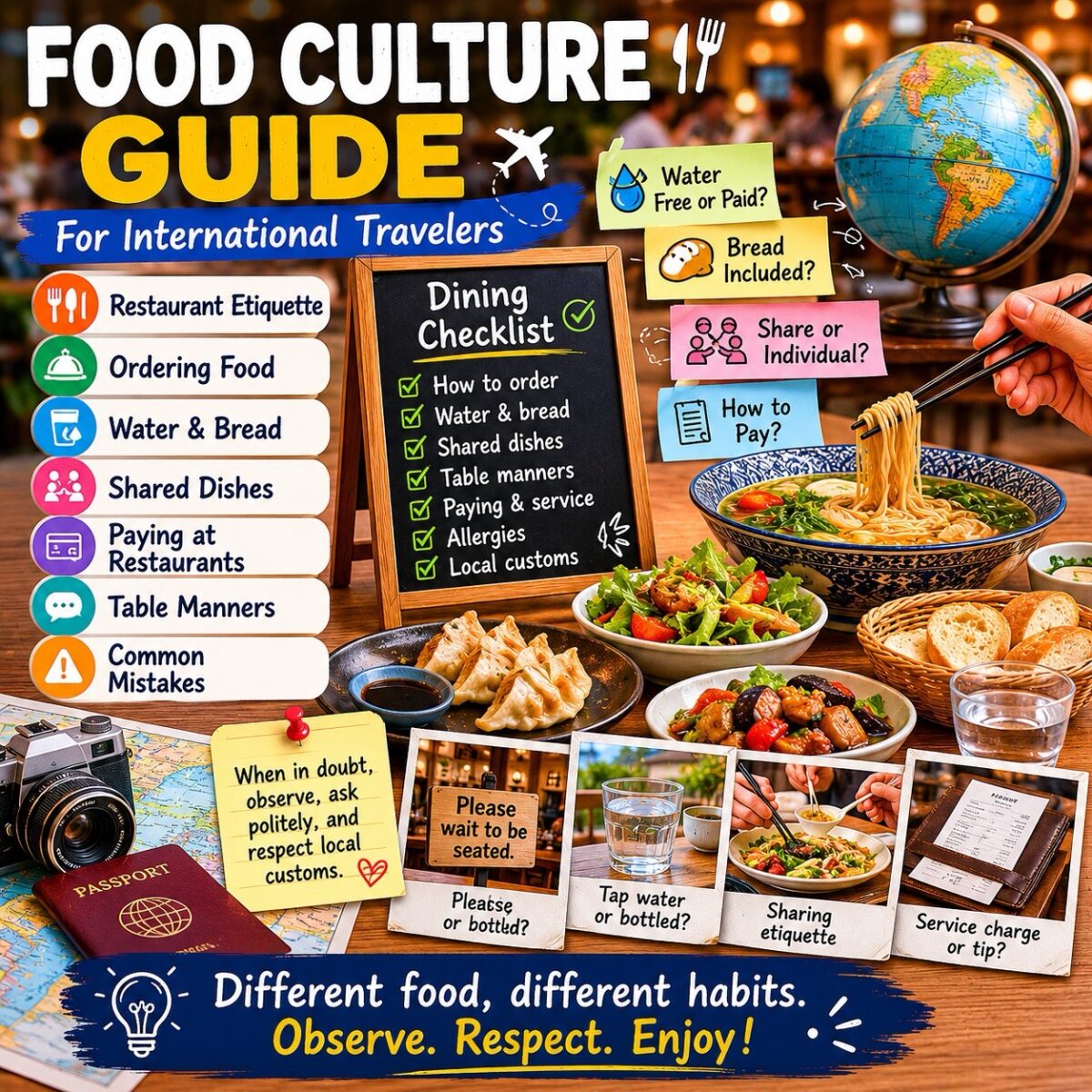
Food culture can affect a trip before the food even arrives. In some countries you wait to be seated, in others you order at the counter; water may be free, paid, bottled, or rarely offered unless you ask.
This food culture guide explains what international travelers should check before eating out abroad, from ordering and paying to shared dishes, table manners, bread, water, and local restaurant habits. The goal is not to memorize every custom perfectly. It is to avoid the small dining mistakes that make a meal feel awkward when you are already hungry, tired, or unsure of the language.
Quick answer: before your first meal abroad, check whether you should wait to be seated, how to order, whether water or bread is included, whether dishes are shared or individual, how to pay, and which table manners matter locally.
What this food culture guide helps you check
Food culture is not only about what people eat. It also shapes how a restaurant works. The entrance, menu, ordering method, portion size, shared dishes, table setup, payment flow, and service style can all feel different from what you are used to at home.
The first thing to check is how to enter and order. Some restaurants expect you to wait at the door until staff guide you to a table. Others let guests choose seats freely. Some places use counter ordering, QR menus, ticket machines, or table-side ordering. A few minutes of observation can prevent an awkward start.
The second thing to check is how the meal is served. Are dishes shared in the middle of the table, or does everyone order an individual plate? Are serving spoons provided? Is bread part of the meal or a charged extra? Is tap water normal, or should you order still or sparkling bottled water?
The third thing to check is how the meal ends. In some countries, the bill comes only when you ask. In others, you pay at the counter. Splitting the bill may be easy in one place and unusual in another. For broader planning by destination, keep LnJGuide country travel guides open while checking local customs and restaurant basics.
Restaurant entry: wait to be seated or seat yourself?
One of the first restaurant questions abroad is simple but surprisingly important: do you wait or sit down? In some countries and restaurant types, a host or staff member seats you. Walking directly to an empty table may look impatient or confusing. In other places, especially casual cafes, food courts, pubs, or small local restaurants, self-seating may be normal.
Look near the entrance. A sign such as “Please wait to be seated,” a host stand, a reservation book, or a queue usually means you should wait. If people are walking in, choosing tables, and ordering at a counter, self-seating may be fine. When unsure, pause at the entrance and make eye contact with staff before sitting.
Reservation culture also varies. In some cities, popular restaurants expect reservations even on weekdays. In others, walk-ins are normal unless it is a special occasion or a famous restaurant. If your trip includes a restaurant you really care about, check the reservation system before arrival rather than waiting until the same day.
Counter service, table service and ticket machines
Not every restaurant works through a waiter. You may order at a counter, pay first, take a number, scan a QR menu, use a kiosk, or buy a meal ticket from a machine before sitting down. This is common in many casual restaurants, bakeries, fast lunch spots, and transport-station food areas.
If there is a line, watch what people do before they order. Do they choose a table first? Do they pick up a tray? Do they pay before receiving food? Do they take their own water and utensils? This small observation is often easier than trying to translate every sign on the wall.
Ordering food abroad when the menu feels unfamiliar
Ordering food abroad can feel stressful when you cannot read the menu quickly. Photos, set menus, daily specials, QR codes, and translation apps can help, but they do not always explain portion size, spice level, ingredients, or whether a dish is meant for sharing.
Start with the structure of the menu. Is it organized by appetizer, main dish, side dish, and dessert? Or does it list noodles, rice, grilled items, shared plates, soups, and drinks separately? In some places, one dish is a full meal. In others, you are expected to order several small dishes for the table.
If you cannot understand a dish, ask politely instead of pretending. Simple questions such as “Is this spicy?”, “Is this for one person?”, “Does this include meat?”, or “Is this a shared dish?” can prevent mistakes. When language is difficult, pointing to photos, using a translation app, or writing down dietary needs can help.
Allergies and dietary restrictions need clear wording
Food allergies and dietary restrictions should be prepared before the meal, not improvised at the table. A translation app may help, but it can miss important details such as cross-contamination, broth ingredients, sauces, seafood paste, nuts, dairy, gluten, or meat stock.
If a food can make you seriously ill, carry a written allergy note in the local language. Include the ingredient, the seriousness of the allergy, and whether cross-contact matters. Vegetarian, vegan, halal, kosher, gluten-free, and dairy-free terms can also vary by country, so check the local wording before relying on a direct translation.
Water, bread and small extras are not the same everywhere
Water is one of the most common dining surprises abroad. In some places, tap water is offered automatically and refilled for free. In others, you may need to ask for tap water, order still bottled water, choose sparkling water, or pay for water as a normal part of the meal.
When a server asks “still or sparkling?”, they may be asking which bottled water you want, not whether you want free water. If you want tap water and it is commonly available, ask clearly. If tap water is not normally served or not safe to drink in that destination, bottled water may be the standard choice.
Bread can also be confusing. A basket placed on the table may be included, charged separately, or part of a cover charge. In some restaurants, refusing it politely at the beginning may prevent an extra charge. In other places, bread is simply part of the meal. The safest habit is to check the menu or bill before assuming.
Traveler mistake to avoid: do not assume water, bread, refills, sauces, side dishes, or small appetizers are free just because they appear on the table. Restaurant customs vary widely.
Shared dishes, individual plates and family-style meals
Some dining cultures center on shared dishes. Plates are placed in the middle, and everyone takes small portions into their own bowl or plate. Other restaurant cultures are more individual, where each person orders one main dish and sharing is optional rather than expected.
Before reaching across the table, watch how the meal is being served. Are there serving spoons or shared chopsticks? Does each person have a small side plate? Are dishes arriving one by one for the group, or are they clearly assigned to individual diners?
Shared dining is not automatically casual. In many places, there are quiet rules about who serves first, whether you use serving utensils, and how much you take at one time. If a dish is meant for everyone, take a modest portion first and leave enough for others. You can usually take more later if the group continues eating.
Double-dipping, touching shared food with personal utensils, or reaching across people can feel rude in some dining settings. In other settings, especially very casual meals, the rules may be more relaxed. When you are unsure, copy the most careful person at the table rather than the fastest eater.
Table manners and utensils abroad
Table manners are one of the easiest parts of food culture to overthink. You do not need to perform local etiquette perfectly to be respectful. Most of the time, travelers do well by slowing down, watching how others eat, and avoiding actions that are clearly treated as impolite.
Utensils vary widely. Some meals are eaten with chopsticks, some with fork and knife, some with a spoon, some with bread, and some with the right hand. The important thing is not to judge the custom out loud. What feels unusual to you may be the normal, respectful way to eat in that place.
Chopstick etiquette is a common example. In Japan, official tourism guidance explains several basic manners, including avoiding sticking chopsticks upright in rice and avoiding passing food from chopsticks to chopsticks. These details matter because they can carry cultural meanings beyond everyday table use.
Korean dining etiquette offers another useful example. Visit Seoul explains that diners commonly start eating after the eldest person at the table begins and that touching food directly with fingers is often avoided except in specific situations. These examples do not mean every meal is formal, but they show why it helps to notice local expectations.
Practical rule: if you are unsure about utensils or shared dishes, pause for a moment and watch. A few seconds of observation usually prevents more awkwardness than a rushed guess.
Paying at restaurants abroad
Payment habits can be just as different as ordering habits. In some countries, servers bring the bill only when you ask. In others, the bill may come automatically near the end of the meal. In casual restaurants, you may need to pay at the counter, scan a QR code, or use a self-service machine.
If you are waiting for the bill and nothing happens, the restaurant may not be ignoring you. It may simply be normal to ask. Phrases such as “Could we have the bill, please?” or a small writing gesture are usually understood in tourist areas.
Splitting the bill also varies. Some restaurants can split by item, some can split evenly, and some prefer one payment per table. If you are traveling with a group, decide how you will pay before the card machine arrives. This is especially helpful in busy restaurants where staff are trying to turn tables quickly.
Service charges and tipping should be checked separately from the meal price. A bill may include a service charge, cover charge, table charge, or gratuity line. That does not always mean the same thing everywhere, so read the bill before adding a tip. If tipping is a major concern for your destination, check a country-specific tipping guide before the meal.
Food restrictions, allergies and dietary needs
Dietary needs are easier to handle when they are prepared before the first restaurant visit. Do not rely only on the English word for an allergy or diet style. In some countries, “vegetarian” may still be interpreted differently if broth, fish sauce, gelatin, lard, or seafood seasoning is common in cooking.
If you have a serious allergy, carry a written note in the local language. It should say what you cannot eat, what can happen if you eat it, and whether cross-contact matters. Keep the wording simple and direct. Restaurant staff may be busy, and a long paragraph translated by an app can be harder to understand than a clear sentence.
For halal, kosher, vegan, vegetarian, gluten-free, dairy-free, nut-free, shellfish-free, or other dietary needs, check local terms before travel. Some restaurants may understand the concept clearly, while others may need specific ingredient names. When in doubt, choose simpler dishes where the ingredients are easier to confirm.
Street food, markets and local food etiquette
Street food and markets can be some of the best parts of travel, but they have their own rhythm. You may need to queue first, pay first, take a number, point at what you want, collect food at another window, or return trays after eating. Watch the flow before stepping in.
Cash can still matter at markets and small stalls, even in countries where restaurants accept cards. Keep small local currency if you plan to eat street food, visit night markets, or buy snacks from small vendors. Do not assume every stall can break large bills.
Where you eat also matters. Some street food is meant to be eaten while walking, while some is meant to be eaten near the stall. In a few places, eating while walking may be discouraged in certain streets, markets, temples, or transport areas. Look for trash bins, tray-return areas, standing counters, or local eating zones.
Common food culture mistakes travelers make
- Sitting down without checking. Some restaurants expect guests to wait to be seated, while others are self-seating.
- Assuming water is free. Tap water, bottled water, still water, and sparkling water are handled differently by country and restaurant type.
- Assuming bread is included. Bread may be free, charged separately, or part of a cover charge.
- Ordering too much or too little. Some menus are built around individual meals, while others expect several shared dishes.
- Ignoring serving utensils. Shared dishes may require serving spoons, shared chopsticks, or a separate small plate.
- Waiting silently for the bill. In some places, you need to ask for the bill or pay at the counter.
- Relying only on brand names or English labels for allergies. Ingredient names and dietary terms may not translate directly.
- Treating whole regions as one culture. Europe, Asia, Latin America, the Middle East, and Africa all contain many different dining customs.
Simple dining checklist before your first meal abroad
- Check how to enter. Look for a host stand, queue, reservation list, or self-seating pattern.
- Check how to order. Table service, counter service, QR menu, ticket machine, and self-service all work differently.
- Ask about water clearly. Tap, still, sparkling, bottled, free, and paid water are not the same everywhere.
- Notice bread and small extras. They may be included, optional, or charged separately.
- Watch the sharing style. Individual plates and shared dishes use different manners.
- Prepare allergy or diet phrases. Use clear local-language notes for serious restrictions.
- Check how to pay. Ask for the bill, pay at the counter, or use a QR system depending on the restaurant.
- Read the bill before tipping. Look for service charge, cover charge, table charge, or gratuity lines.
- Respect local timing. Meal hours, closing times, and peak dinner times can be very different from home.
A food culture guide cannot cover every dining rule in every country, but it can help you notice the right questions. Before your first meal, check how people enter, order, share, drink water, use utensils, and pay. Those small details often matter more than knowing the name of every dish on the menu.
The best travel meals usually happen when you are curious, patient, and respectful. Observe first, ask politely when needed, and enjoy the fact that different places have different tables.
Sources and official references:
FAQ
What is food culture?
Food culture is the way people eat, serve, share, order, pay, and behave around meals. It includes restaurant etiquette, table manners, local ingredients, meal timing, shared dishes, drinks, service style, and the social meaning of eating together.
How do I know if I should wait to be seated abroad?
Look near the entrance for a host stand, sign, queue, reservation book, or staff member. If other guests wait at the door, you should probably wait. If people choose tables freely and order at a counter, self-seating may be normal.
Is tap water free in restaurants abroad?
Not always. In some countries, tap water is free and offered automatically. In others, you may need to ask for it, or bottled water may be the normal option. If a server asks “still or sparkling,” they may be offering bottled water rather than free tap water.
Is bread free at restaurants abroad?
It depends on the country and restaurant. Bread may be included, charged separately, or part of a cover charge. If you do not want it, ask politely before eating it, especially when the menu or bill suggests a bread or table charge.
How can I order food if I cannot read the menu?
Use photos, set menus, translation apps, and simple questions. Ask whether a dish is spicy, whether it is for one person, whether it contains meat or seafood, and whether it is meant to be shared. For allergies, carry a clear local-language note.
Is it rude to share food abroad?
Sharing food is normal in many dining cultures, but not everywhere. Some meals are built around shared dishes, while others are served as individual plates. Watch whether people use serving utensils, small plates, or shared chopsticks before taking food.
What table manners should travelers check?
Check how people use utensils, whether dishes are shared, whether elders or hosts start first, whether eating with hands is normal, and whether certain utensil gestures are considered rude. You do not need to be perfect, but you should avoid careless or mocking behavior.
How do I handle allergies when eating abroad?
Prepare written allergy notes in the local language before the trip. Include the ingredient, the seriousness of the allergy, and whether cross-contact matters. Do not rely only on brand names, English labels, or direct translations of diet words.