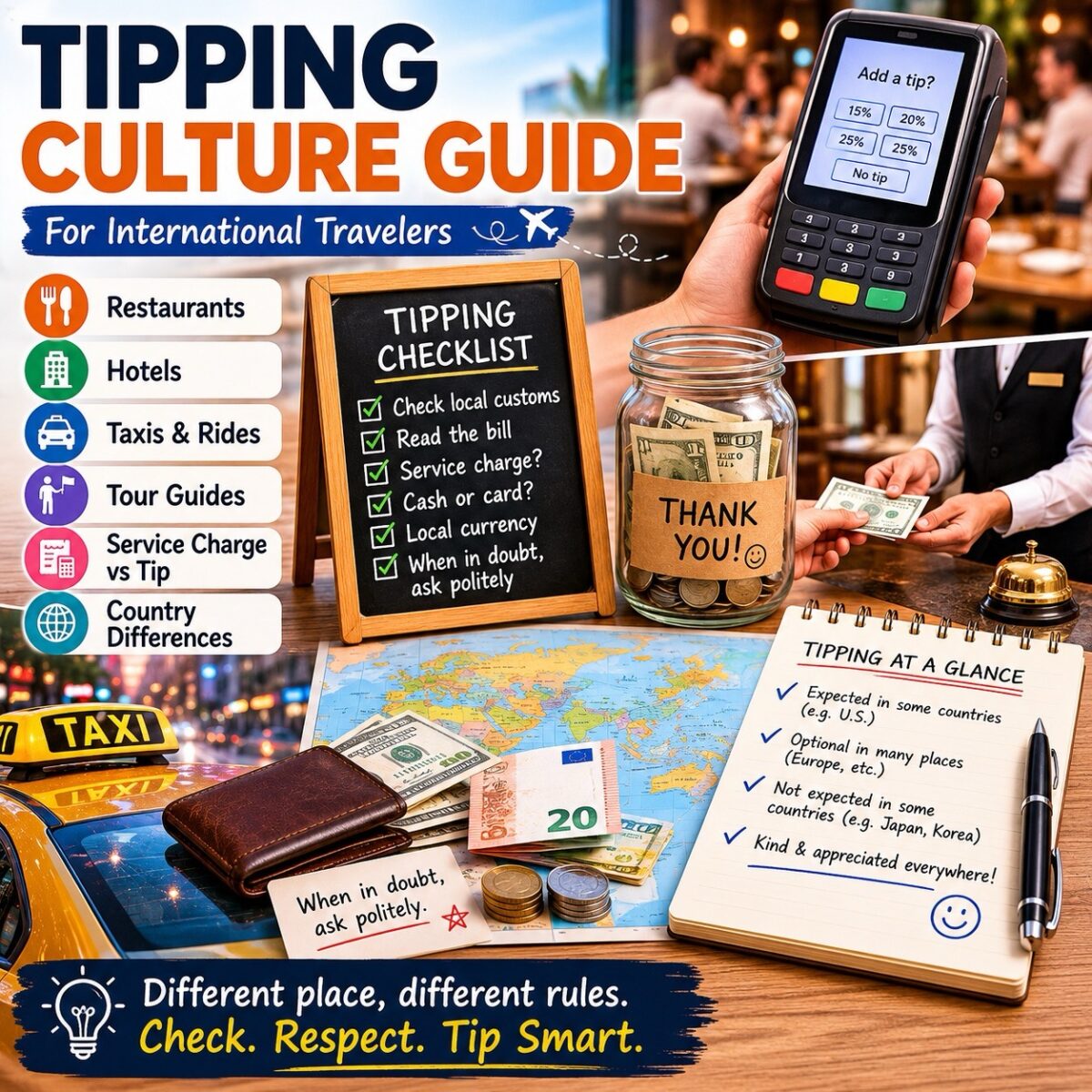
Tipping culture can be one of the most awkward parts of international travel because the same action can mean different things in different countries. In one place, not tipping at a restaurant may look rude; in another, leaving cash on the table may confuse staff or feel unnecessary.
This tipping culture guide explains what travelers should check before paying at restaurants, hotels, taxis, tours, spas, and delivery services abroad. The goal is not to memorize one global tipping percentage. It is to understand whether tipping is expected, optional, already included, or uncommon in the place you are visiting.
Quick answer: before tipping abroad, check whether a service charge is already included, whether tips are expected in that country, whether cash or card is more practical, and whether local currency is preferred.
What this tipping culture guide helps you check
The first question is simple: is tipping expected, optional, or uncommon? Some countries have a strong tipping culture, especially in restaurants, bars, taxis, and tour services. In other places, tipping is appreciated but not expected. In a few destinations, tipping may feel awkward or unnecessary in everyday situations.
The second question is whether a service charge is already included. A bill may list “service charge,” “service fee,” “cover charge,” “gratuity,” or a similar line. Sometimes this charge goes to staff, sometimes it is part of the restaurant’s pricing structure, and sometimes it may be optional. Because the wording can vary, reading the bill matters more than guessing.
The third question is how to tip. Cash is still useful in many places, especially for hotel porters, housekeeping, small cafes, taxis, and tour guides. But some countries are increasingly cashless, and card terminals may ask whether you want to add a tip. For broader planning by destination, keep LnJGuide country travel guides open while checking local customs and travel basics.
Service charge vs tip: read the bill first
The easiest tipping mistake is paying twice without realizing it. This often happens when a traveler sees a suggested tip screen or leaves cash even though the bill already includes a service charge. In restaurants, the service charge line is usually the first thing to check before deciding whether to add anything extra.
A service charge does not always mean the same thing in every country. In some places, it is the normal way restaurants include staff service in the bill. In others, it may be an optional charge that guests can ask to remove if service was poor. Some restaurants automatically add service charges for larger groups, while others add them to all bills in tourist areas.
If the bill is unclear, ask politely. A simple question such as “Is service included?” or “Is the service charge already included?” is usually enough. This is better than making assumptions from your home country’s tipping habits.
Traveler mistake to avoid: do not tip only because a card terminal shows 15%, 20%, or 25%. Tip prompts are becoming common in many places, but the screen does not always reflect the local expectation.
Restaurant tipping abroad
Restaurants are where tipping questions feel most immediate. The meal is finished, the bill arrives, and everyone at the table starts wondering what is normal. The answer depends on the country, restaurant type, and whether service is already included.
At a sit-down restaurant, first read the bill. If there is no service charge and tipping is expected in that country, a tip may be appropriate. If a service charge is already listed, adding more may be optional rather than necessary. In some places, rounding up the bill or leaving small change is normal. In others, a percentage-based tip is expected.
Cafes, bakeries, food courts, and counter-service restaurants are different. A tip jar or screen may appear, but that does not automatically mean the local culture expects a tip for every coffee or takeaway order. In many places, small tips at casual counters are appreciated but not required.
Bars, drinks and casual service
Bars have their own rhythm. In some countries, tipping per drink is normal. In others, it is enough to round up or leave small change at the end. If you are paying each time you order, watch how locals handle the payment. If most people simply pay the listed price, a large tip may not be expected.
For hotel bars, rooftop bars, or tourist-heavy restaurants, tipping expectations can feel closer to international hospitality norms than to local everyday habits. This is why tourist districts sometimes feel different from residential neighborhoods in the same country.
Fine dining and group meals
Fine dining often has clearer service-charge rules, but the bill should still be checked carefully. Some restaurants add a percentage automatically, especially for groups. If the charge is already included, an additional tip may be a small thank-you for exceptional service rather than a standard requirement.
For group meals, decide before paying whether one person will handle the tip or everyone will add separately. This avoids the common problem where several travelers each add a little extra without noticing that the service charge was already included.
Hotel tipping: porter, housekeeping, concierge and room service
Hotel tipping is more situation-based than restaurant tipping. You may never need to tip at a simple self-service hotel, but tipping may be more common when staff carry luggage, arrange special requests, deliver room service, call taxis, or provide concierge help.
Porters and bell staff are the easiest example. If someone carries heavy luggage to your room, a small cash tip in local currency may be appreciated in countries where hotel tipping is common. If you carry your own bag and use self check-in, there may be no tipping moment at all.
Housekeeping tips are more variable. In some countries, guests leave a small amount daily because housekeeping staff may change from day to day. In other places, hotel tipping is not a strong expectation. If you do leave a housekeeping tip, place it clearly with a short note so it is not confused with forgotten money.
Concierge tipping depends on the request. Asking for directions or a restaurant name does not always require a tip. But if a concierge arranges a difficult reservation, solves a travel problem, or helps with a special request, tipping may be appropriate in destinations where hotel tipping is common.
Room service can also be confusing because delivery charges, service charges, and gratuity lines may already be included. Read the receipt before adding more. If the bill already includes a service charge, an extra tip is usually optional rather than automatic.
Taxi, ride-hailing and airport transfer tipping
Taxi tipping is one of the easiest places to adapt to local habits. In some countries, passengers commonly round up the fare. In others, a percentage tip may be expected. In places where tipping is uncommon, simply paying the metered or app fare may be enough.
Airport transfers can be different from short city taxi rides. If the driver helps with heavy luggage, waits during a delay, carries bags into a hotel lobby, or provides a private transfer service, a tip may be more expected than for a quick ride across town. Still, check the country’s custom before assuming a fixed percentage.
Ride-hailing apps often include a tip option after the ride. This can be convenient, but it can also make tipping feel more universal than it really is. The app may use the same interface across several countries, while local expectations differ. If tipping is optional, use the app prompt as a choice, not a rule.
Tour guides, drivers, spas and special services
Guided tours are one of the situations where tipping can matter more to travelers. A guide may spend several hours or a full day explaining local history, managing timing, helping with tickets, and solving small problems. In countries where tipping is common, guides and drivers may expect tips more than restaurant staff do.
Private tours and group tours are different. On a private tour, the service is more personal, and a tip may be more noticeable. On a group tour, travelers may contribute individually or as a group. Multi-day tours can involve several people, such as a guide, driver, porter, cook, or local assistant. Check the tour company’s guidance before the trip so you are not deciding under pressure at the end.
Spa, massage, salon, and personal services also vary. In some destinations, tipping is normal for personal services. In others, the listed price is treated as complete. If the service is inside a hotel or resort, check whether a service charge is already included before adding anything extra.
Countries where tipping is expected, optional or uncommon
It is tempting to divide the world into simple tipping countries and no-tipping countries, but real travel is messier. Tipping can differ between restaurants and hotels, local neighborhoods and tourist zones, city taxis and private drivers, or casual cafes and luxury resorts.
In the United States, tipping feels stronger than in many other destinations because tipped-service work is part of the wage structure in several industries. Official U.S. government wage information explains that tipped employees may receive a separate cash wage structure as long as wages and tips meet minimum wage requirements. This is one reason restaurant and service tipping can feel more expected in the U.S. than in many other countries.
In many European destinations, tipping may be more modest or optional, especially where service is already included or staff wages do not depend on tips in the same way. VisitBritain, for example, explains that tipping is not expected in Britain in the way it is in some other countries, although it may be polite for good service and some restaurants add a service charge automatically.
In some Asian destinations, everyday tipping may be uncommon and sometimes unnecessary. That does not mean no one ever accepts a tip, especially in international hotels or tourism services, but travelers should avoid forcing their own tipping habits onto a culture where tipping is not part of the normal payment routine.
Simple rule: do not treat a whole continent as one tipping rule. Check the country, the service type, and the bill before deciding.
Cash, card and local currency tipping tips
Local currency is usually the safest way to tip. Small bills and coins are useful for hotel staff, taxi rounding, small cafes, and local guides. Foreign coins are often a poor tip because they may be hard or impossible for staff to exchange.
Card tipping works well in some countries, but not everywhere. A restaurant may allow card tips, while a hotel porter or tour driver may only be able to accept cash. In very cashless cities, the opposite may happen: a card or app tip may be more practical than trying to find small bills.
If you plan to tip in cash, prepare small amounts before you need them. It is awkward to ask a hotel porter to wait while you search for change. It is also awkward to tip too much only because you have no smaller bills. A small local-currency envelope or separate wallet pocket can make this easier.
Common tipping mistakes travelers make
- Tipping twice by mistake. Always check whether a service charge or gratuity is already included.
- Assuming one percentage works everywhere. A normal tip in one country may feel excessive or too low in another.
- Ignoring local no-tipping habits. In some places, tipping is uncommon and may not be expected for everyday service.
- Leaving foreign coins. Coins from another currency may be difficult for staff to use or exchange.
- Following card prompts blindly. A payment screen may suggest tips even where tipping is optional.
- Forgetting tour guides and drivers. In some destinations, guides and private drivers are more tip-dependent than restaurant staff.
- Not reading the room-service bill. Delivery fee, service charge, and gratuity can be separate lines.
- Treating tourist zones as the whole country. Resorts and major tourist areas may have different expectations from local neighborhoods.
Simple tipping checklist before you travel
- Check the destination norm. Is tipping expected, optional, modest, or uncommon?
- Read restaurant bills carefully. Look for service charge, gratuity, cover charge, or optional service lines.
- Prepare small local currency. Useful for hotels, taxis, guides, and small services.
- Check card tip prompts. Treat the screen as an option, not proof that tipping is required.
- Review hotel situations. Porter, housekeeping, concierge, and room service may follow different customs.
- Check tour guidance. Private tours, group tours, multi-day tours, and drivers may have specific tipping expectations.
- Do not tip twice automatically. If service is included, any extra should be a choice.
- Ask politely when unsure. “Is service included?” is usually enough.
A tipping culture guide cannot give one perfect rule for every country, but it can help you avoid the most common mistakes. Read the bill first, check the local expectation, use local currency when cash is appropriate, and remember that the same gesture can feel different depending on where you are.
The safest travel habit is not to tip more or less everywhere. It is to tip with context. Check the country, respect the service culture, and use tipping as a polite thank-you where it fits.
Sources and official references:
FAQ
What is tipping culture?
Tipping culture is the local expectation around giving extra money for service. It can include restaurants, hotels, taxis, guides, spas, delivery, and other travel services. In some countries tipping is expected, in others it is optional, and in some places it is uncommon in everyday situations.
Is service charge the same as a tip?
Not always. A service charge may already cover service, or it may be an added restaurant fee. In some places it goes to staff, while in others the meaning can vary. Before adding a tip, read the bill and ask politely if service is already included.
How much should I tip at restaurants abroad?
There is no single global percentage. In some countries, a percentage tip is expected. In others, rounding up or leaving small change is enough. If a service charge is already included, an additional tip may be optional rather than necessary.
Is tipping expected in the United States?
Yes, tipping is commonly expected in many U.S. service situations, especially sit-down restaurants, bars, taxis, hotel services, and guided tours. The exact amount depends on the service type and situation, but travelers should expect tipping to be more common in the U.S. than in many other countries.
Is tipping required in Europe?
Europe does not have one tipping rule. In many places, tipping is more modest or optional, and service may already be included. Some restaurants add a service charge, while others do not. Check the bill and local custom before deciding.
Is tipping rude in some countries?
In some places, tipping is uncommon and may feel unnecessary or awkward in everyday settings. International hotels and tourist services may be different, but it is better to check local expectations instead of assuming your home tipping habit applies everywhere.
Should I tip in cash or by card?
Local-currency cash is often useful for small tips, hotel staff, taxis, and guides. Card tips may work well in restaurants or cashless cities. Avoid foreign coins, and do not assume a card terminal tip prompt means tipping is required.
Do I tip tour guides and drivers?
In many destinations, tour guides and private drivers are common tipping situations, especially for private, full-day, or multi-day tours. Check the tour company’s guidance before the trip, because expectations can differ by country and tour type.