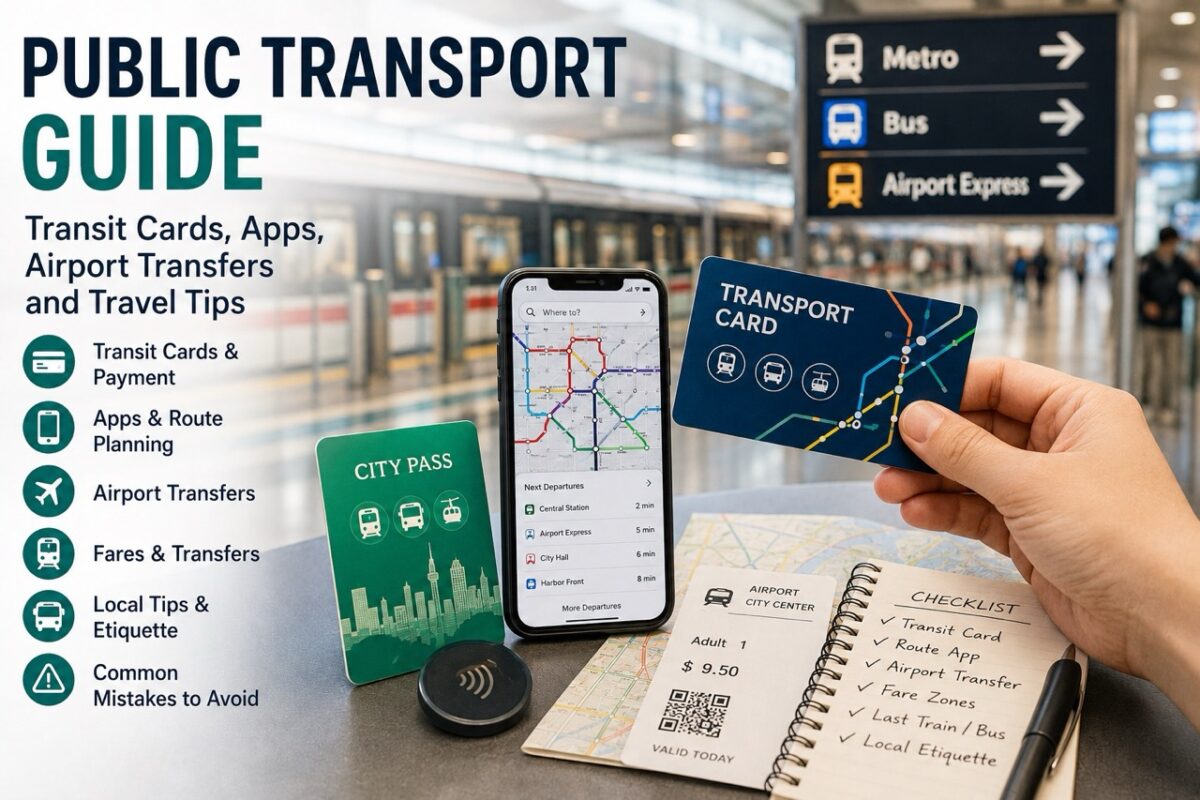
Public transport abroad can be confusing because every city has its own payment system, transfer rules, airport routes, and local apps. A card that works on the metro may not work on every bus, and a contactless payment option may still require tap-in and tap-out rules.
This public transport guide explains what to check before your first ride, from transit cards and mobile route apps to airport transfers, fare zones, rush hours, and common mistakes. The goal is not to master the whole city network on day one. It is to avoid the small transport mistakes that can waste time right after arrival.
Quick answer: before using public transport abroad, check how to pay, which app locals use, whether the airport route needs a separate ticket, how transfers work, and whether you must tap out when leaving the station or bus.
What to check before using public transport abroad
The first thing to check is not the full map. It is the transport you will actually use. Many travelers only need three or four routes during a trip: airport to hotel, hotel to the main sightseeing area, hotel to a train station, and one or two evening return routes. Start there before trying to understand every line on the map.
Next, check the fare system. Some cities use flat fares, where one ride costs the same within a basic area. Others use zones, distance-based fares, peak-hour pricing, or special airport fares. This matters because the cheapest-looking ticket may not cover the route you plan to take.
Payment is the next layer. Depending on the city, you may need a local transit card, a contactless bank card, a mobile wallet, a QR ticket, a paper ticket, or cash for certain buses. Do not assume that “public transport accepts cards” means every mode accepts every card. The metro, airport train, city bus, ferry, and regional rail may follow different rules.
For broader trip planning before you choose a route, you can also keep LnJGuide country travel guides open while checking local transport, airport access, and travel basics for your destination.
Transit cards, contactless payment and tourist passes
Most big cities offer more than one way to pay for public transport. The best option depends on how long you stay, how often you ride, whether your bank card works abroad, and whether the airport route is included.
| Payment option | Best for | What to check |
|---|---|---|
| Local transit card | Frequent metro, bus, tram, or rail rides | Deposit, top-up method, refund rules, airport coverage |
| Contactless bank card or mobile wallet | Short city trips where supported | Foreign card acceptance, tap-in/tap-out rule, fare caps |
| Tourist pass | Heavy sightseeing days or bundled museum access | Validity area, included routes, whether you will ride enough |
| Paper or QR ticket | One-off rides, airport tickets, regional routes | Validation rule, time limit, zone coverage |
| Cash | Some local buses, rural routes, older systems | Exact fare, boarding method, change availability |
A tourist pass is not automatically cheaper. It can be useful when it includes airport transport, unlimited rides, or attractions you already plan to visit. But if your hotel is walkable and you only take one or two rides per day, pay-as-you-go may cost less.
Contactless payment can be convenient, but it comes with one important rule: use the same card or device for the whole journey. If you tap in with a physical card and tap out with a phone wallet linked to the same card, the system may treat them as different payment methods. That can lead to an incomplete journey charge in some cities.
Local transit cards are often safer for travelers who want predictable transport spending. They can also work on convenience-store purchases, lockers, vending machines, or taxis in some countries. Still, check refund rules. A card deposit may be refundable only at certain counters, and unused balance may not be worth chasing on your final day.
Public transport apps and route planning
A route app can make public transport abroad much easier, but the best app is not always the one you use at home. In some countries, Google Maps or Apple Maps work well for metro and bus planning. In others, a local app may show better real-time arrivals, station exits, platform numbers, fare details, or service disruptions.
Before your first ride, install at least one route app and test it while you still have hotel Wi-Fi. Search the route from the airport to your hotel, your hotel to the main train station, and your hotel to one late-night return point. If the app shows multiple options, compare travel time, number of transfers, walking distance, stairs, and last service time. The fastest route is not always the easiest route with luggage.
Save important station names in both English and the local language when possible. Some signs use romanization, but not all station exits, bus stops, or neighborhood names are translated clearly. A screenshot of your destination station, exit number, and final walking direction can help if mobile data is weak underground.
Official transit apps vs general map apps
Official transit apps are often better for service alerts, fare rules, and line disruptions. General map apps are usually easier for walking directions and comparing several transport modes. A good habit is to use both: check the route in a general map app, then verify important details in the official transit app or website when timing matters.
Real-time arrivals are not the same as schedules
Some apps show real-time arrivals based on vehicle location. Others show scheduled times only. This difference matters late at night, during holidays, in bad weather, or on bus routes with traffic delays. If the app does not clearly say whether the arrival is real-time, leave extra buffer before airport trains, long-distance trains, and timed tickets.
Airport transfers by public transport
Airport public transport is often the first test in a new city. It may be cheap and reliable, but it is not always the easiest option after a long flight. Before choosing airport rail, metro, express train, airport bus, or local bus, check three things: where the stop is, how much luggage you have, and what time you arrive.
Airport express trains can be comfortable and fast, but they may use separate tickets or different fare gates from the normal city metro. Local metro lines are often cheaper, but they may involve stairs, crowded carriages, and more transfers. Airport buses can be useful for hotels far from train stations, but traffic can make travel time less predictable.
If you arrive late at night, check the last train or bus before you land. Some airport routes run 24 hours, but many do not. A train that looks perfect at 7 p.m. may not be available after midnight. If your flight is delayed, you may need a backup plan such as a night bus, airport shuttle, taxi, or rideshare.
Luggage also changes the best route. A transfer that looks easy on a map may involve stairs, long corridors, narrow ticket gates, or a crowded platform. If you are carrying a large suitcase, compare the number of transfers and walking distance, not just the total travel time.
Fare zones, transfers and tap-in/tap-out rules
Fare rules are where many visitors make small but expensive mistakes. In some cities, you pay a flat fare. In others, the price depends on distance, zones, operator, peak time, or whether you transfer within a certain time window. Airport stations and express trains may also have special fares.
Tap-in and tap-out rules are especially important. Some systems require you to tap at the beginning and end of the journey so the correct fare can be calculated. Other systems, especially buses or trams in some cities, may only require one tap. If you forget to tap out where it is required, you may be charged a maximum fare or have trouble using the same card later.
Use the same card or device for the entire journey. If you tap in with a bank card and tap out with a phone wallet, the system may not recognize it as the same trip. This matters even if the phone wallet is linked to the same physical card. When you are tired after a flight, this is an easy mistake to make.
Transfers also vary. Some cities allow free or discounted transfers within a time limit. Others require a new fare when you change from metro to bus, bus to rail, or one operator to another. If you plan to make several short rides in one day, look for fare caps, day passes, or transfer rules before paying ride by ride.
Traveler mistake to avoid: do not buy a pass only because it says “unlimited.” Check whether it covers the airport, your hotel zone, night buses, regional rail, ferries, or the specific operator you will use.
Bus, metro and train differences tourists miss
Metro systems are usually easier for first-time visitors because the route is fixed, stations are named clearly, and trains come often. Buses can be more flexible, but they require a little more local knowledge. You may need to know which door to board from, whether to tap when boarding or exiting, whether to press a stop button, and whether the driver accepts cash.
In some cities, buses stop automatically at every stop. In others, they only stop when someone presses the button or when a passenger is waiting clearly at the stop. If you are unsure, watch local passengers during the first few minutes of the ride. This is often faster than trying to decode every rule on the sign.
Trains can also have local surprises. Express trains may skip your station. Airport trains may cost more than standard trains. Regional trains may require a different ticket from city metro rides. In Japan, for example, official tourism guidance notes that not all buses accept IC cards, so travelers may need to check for IC symbols or pay cash on some routes.
Safety, accessibility and luggage tips
Public transport is usually one of the most practical ways to move around a city, but it still helps to travel with basic awareness. Keep your phone and wallet secure near ticket gates, station exits, escalators, and crowded train doors. These are the places where people slow down, check maps, or become distracted.
If you are traveling with a stroller, wheelchair, heavy suitcase, or older family member, check accessibility before choosing a route. A station with an elevator on one side may still require stairs at another exit. A route that is step-free in the station may have a long walk above ground. Station exit numbers can matter as much as the station name.
Rush hour is another practical issue. A metro ride that feels easy at 11 a.m. may be uncomfortable at 8 a.m. with a large suitcase. If your schedule is flexible, avoid carrying luggage on commuter lines during peak hours. For airport returns, leave earlier than the app’s fastest estimate, especially if you need to top up a card, find the right platform, or use a ticket machine in another language.
Common public transport mistakes to avoid
- Assuming one card works everywhere. A transit card may work on metro lines but not on all buses, ferries, regional trains, or airport express services.
- Not checking airport fares. Airport stations often have different tickets, surcharges, or express services.
- Buying the wrong tourist pass. A pass is useful only if it covers the zones and routes you will actually use.
- Forgetting to tap out. In systems that calculate fares by distance or zone, missing the exit tap can lead to a higher fare.
- Using different devices for one trip. A bank card and a phone wallet may be treated as separate payment methods.
- Following only the fastest route. The fastest route may have more stairs, crowded transfers, or a tight connection.
- Ignoring the last train or bus. Night service can be very different from daytime service.
- Boarding an express train by mistake. Express, limited-stop, and airport trains may skip smaller stations or require a separate ticket.
First-ride checklist for a new city
- Choose your payment method. Decide whether you will use a local transit card, contactless card, mobile wallet, ticket, or cash.
- Check the airport route. Confirm whether the airport train, bus, or metro needs a special ticket or separate fare.
- Install a useful route app. Test your hotel, airport, and main station routes before your first ride.
- Learn the tap rule. Check whether you need to tap in only, or tap in and tap out.
- Check transfer rules. Look for time limits, operator changes, fare zones, and whether bus-to-metro transfers are included.
- Save important station names. Keep screenshots of your hotel station, exit number, and return route.
- Check the last service. Know your late-night return option before dinner, not after the final train has left.
- Plan for luggage. Check elevators, station exits, and crowded transfer points if you have large bags.
- Watch local boarding habits. Bus doors, stop buttons, priority seats, and queue lines can vary by city.
A public transport guide can help you prepare, but the most useful habit is to check the local system before your first ride. Spend five minutes confirming payment, route, transfer, and last service details. That small check can prevent many of the problems visitors face after a long flight.
The best public transport choice is not always the cheapest or fastest one. It is the route that matches your luggage, arrival time, comfort level, and destination. Once you understand how the local payment and transfer system works, the city becomes much easier to explore.
Sources and official references:
- Transport for London: Best ways for visitors to pay
- Transport for London: Pay as you go with contactless and Oyster
- Go Tokyo: Cheap Tickets and IC Cards
- Japan National Tourism Organization: How to travel by train and bus in Japan
- Hong Kong Tourism Board: Getting around Hong Kong
- Visit Korea: Transportation Cards
- World Bank: Transport
FAQ
What is the best way to pay for public transport abroad?
The best payment method depends on the city. Some places are easiest with a local transit card, while others support contactless bank cards, mobile wallets, paper tickets, QR tickets, or cash on certain buses. Before your first ride, check the official transport website for accepted payment methods and tap-in or tap-out rules.
Should I buy a tourist transport pass?
A tourist pass can be useful if you will ride often, travel across several zones, use airport transport, or visit attractions included in the pass. It is not automatically cheaper. Compare the pass price with the rides you realistically plan to take.
Can I use a contactless card on public transport in every city?
No. Contactless payment is common in some cities but not universal. Even where it is accepted, it may work on metro and rail but not on every bus, ferry, regional train, or airport route. Always check local rules before relying on one card.
How do I know whether to tap out?
Check signs at ticket gates, buses, tram stops, or the official transit website. Distance-based or zone-based systems often require both tap-in and tap-out. Some bus or tram systems require only one tap. If you are unsure, watch local passengers or ask station staff.
Is airport rail cheaper than a taxi?
Airport rail or metro is often cheaper than a taxi, especially for solo travelers. But the best option depends on arrival time, luggage, hotel location, stairs, transfers, and whether the airport route has a special fare. Late-night arrivals may need a backup plan.
What public transport app should I use when traveling?
Use a general map app for route comparison and the official transit app or website for service alerts, fares, and disruptions. In some cities, local apps provide better station exits, real-time arrivals, and transfer details than global map apps.
What mistakes do tourists make on buses and metros?
Common mistakes include buying the wrong pass, forgetting to tap out, using different cards for one trip, taking an express train that skips the stop, assuming airport routes are included, and not checking the last train or bus before going out at night.